
How AI Reads Your ERP to Automate Customer Service
Discover how AI in ERP uses API integration and natural language processing to resolve ISP customer requests instantly, without any human intervention.
- AI in ERP
- API Integration
- ISP Automation
- Customer Service
- NLP
The End of Manual System Lookups
If you run an Internet Service Provider (ISP), you know the daily struggle. Your support team spends hours answering WhatsApp messages, opening your management software, looking up a customer's CPF or contract, generating a PDF, and sending it back. It is a slow, repetitive, and expensive cycle.
But what if the system could do this on its own? The implementation of AI in ERP is changing the game. Instead of relying on a human attendant to act as a bridge between the customer and your database, modern AI directly reads your software, processes the request, and delivers the solution instantly.
This is not about old-school, frustrating chatbots that force customers to press numbers. We are talking about advanced AI in customer service that actually understands what the client wants and knows exactly where to find it.
How Natural Language Processing Changes the Game
To understand how an AI reads your system, we first need to understand how it reads the customer. In the past, bots relied on rigid decision trees. If the customer didn't type the exact keyword, the bot would fail. Today, AI uses natural language processing (NLP).
NLP allows the AI to understand context, slang, and intent. If a customer types, "Hey, my internet is off and I think I forgot to pay, can you send me the barcode?", the AI doesn't get confused. It identifies the core intent: the customer needs a duplicate bill to restore their connection.
However, understanding the problem is only half the battle. To solve it, the AI needs access to your data.
The Core Engine: API Integration
For an AI to read your ERP, they need a common language. This is where API integration comes in. An API (Application Programming Interface) is essentially a secure tunnel that allows two completely different software systems to talk to each other.
When you connect a smart assistant to your ISP's management software, you are giving it a secure set of keys. The AI can ask the ERP specific questions—like "What is the billing status of the customer with this phone number?"—and the ERP replies instantly with the raw data.
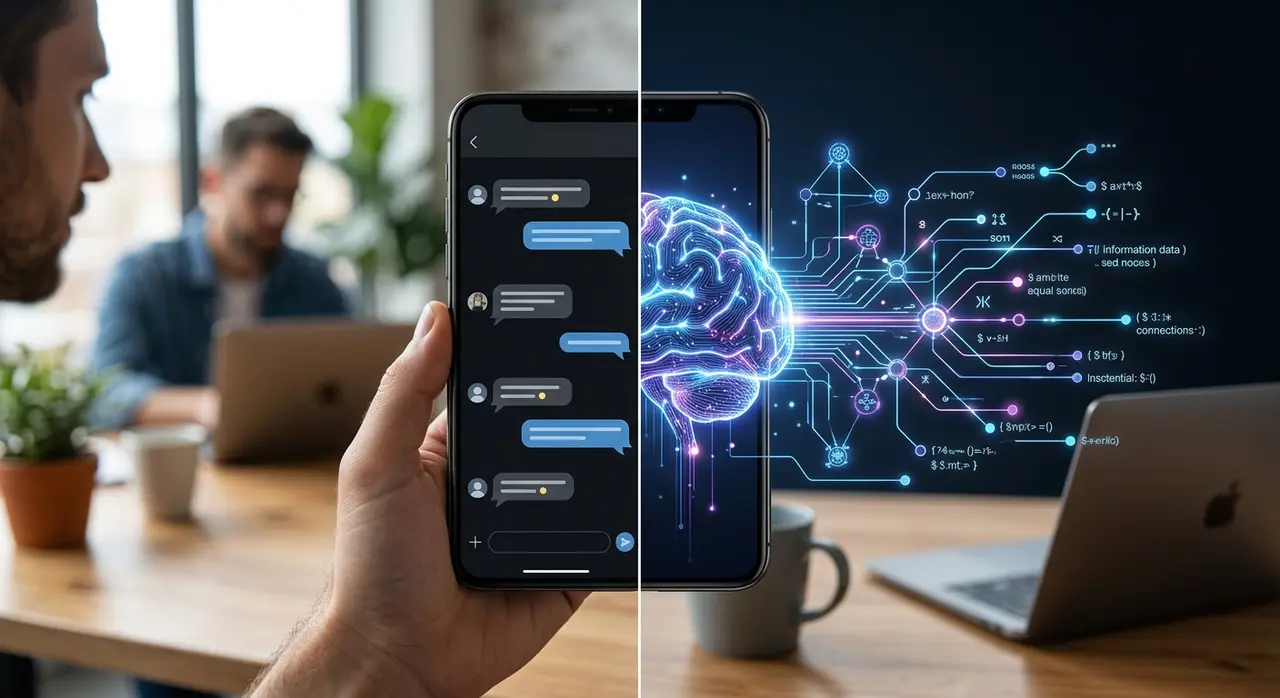
This allows you to extract value from IXC, SGP & TOPSAPP or any other modern system you use. The AI does not need a visual interface; it reads the code directly, making the process lightning-fast and entirely invisible to the customer.
The Ask-Query-Answer Cycle Explained
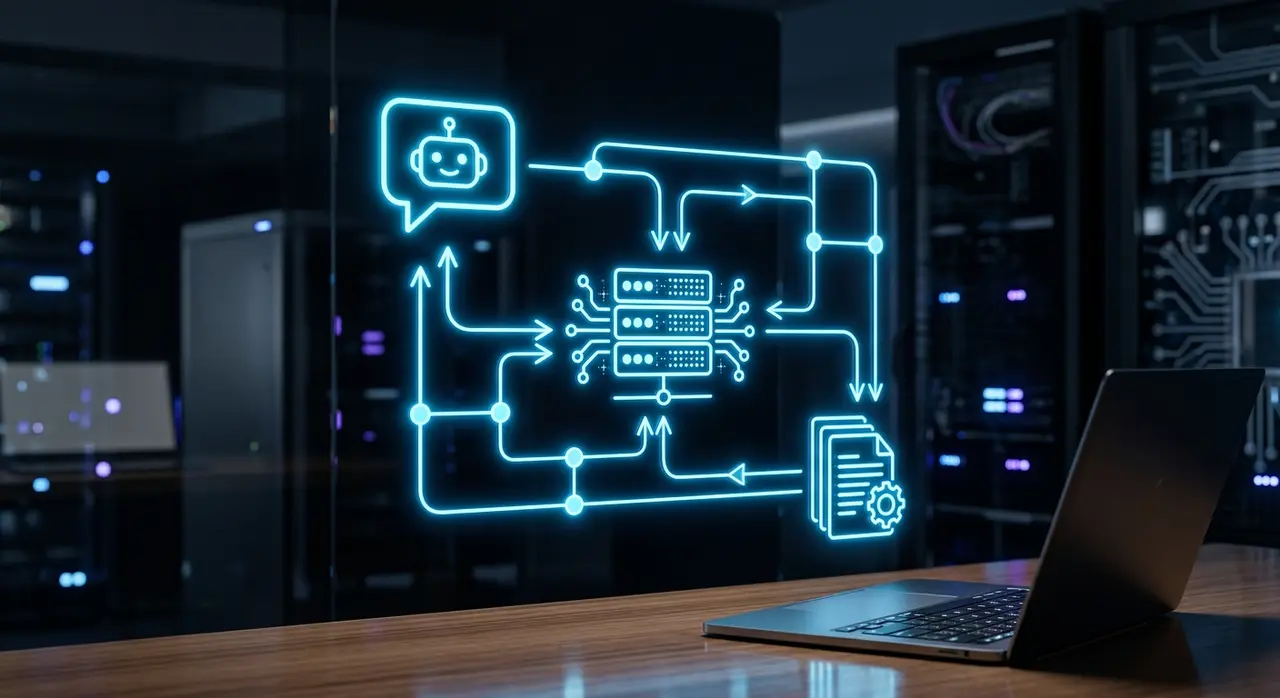
So, how does this look in practice? Let's break down the exact cycle of an AI service agent handling a request from start to finish, completely without human intervention.
- 1. The Ask (Authentication & Intent): The customer sends a WhatsApp message. The AI instantly recognizes the phone number and uses NLP to understand the request (e.g., "I need my invoice"). It may ask for a CPF/CNPJ to confirm identity.
- 2. The Query (Data Retrieval): The AI uses API integration to ping your ERP. It sends the CPF and asks for the latest open invoice. The ERP searches its database and returns the PDF link and barcode to the AI.
- 3. The Logic (Business Rules): Before sending the bill, the AI checks your rules. Is the customer blocked? Are there multiple open invoices? The AI adapts its behavior based on the data it found.
- 4. The Answer (Resolution): The AI formats a polite, human-like message: "Here is your invoice for this month, John! Let me know if you need anything else." It attaches the PDF and the barcode.
The entire process takes less than 5 seconds. The customer is happy, and your human team didn't even have to open the ticket.
Enforcing Business Rules Without Humans
One of the biggest fears ISP owners have is losing control. "Will the AI accidentally give away free internet?" The answer is no, because an intelligent AI strictly follows your business rules.
Let's take a "trust unlock" (desbloqueio em confiança) as an example. A customer whose internet is blocked for non-payment asks the AI to restore their connection for a few days until they get paid.
Instead of just saying "yes," the AI queries the ERP. The ERP replies with the customer's history. The AI reads this data and applies your specific rules:
- Has the customer already used a trust unlock this month?
- Are they more than 30 days late?
- Is their contract eligible for this feature?
If the ERP data shows they already used the unlock, the AI will politely deny the request, explaining the policy. If they are eligible, the AI will trigger the API to unblock the connection in the software, instantly restoring the internet. This is how you automate trust unlocks securely and efficiently.
Traditional Bots vs. Intelligent AI Service Agents
To make the difference clear, let's look at how traditional chatbots compare to modern AI integrated with your ERP.
| Feature | Traditional Chatbot | AI Service Agent with ERP Integration |
|---|---|---|
| Understanding | Relies on exact keywords or numbered menus (Press 1 for Finance). | Uses NLP to understand complex sentences, audio, and context. |
| ERP Access | Usually none, or very limited (can only send a generic link). | Deep API integration reads and writes data directly in the system. |
| Problem Solving | Creates a ticket and puts the customer in a queue. | Solves the issue instantly (sends bills, unlocks connections, checks outages). |
| Tone of Voice | Robotic, repetitive, and frustrating. | Humanized, dynamic, and empathetic. |
Knowing the Limits: When the AI Steps Back
While AI is incredibly powerful, it is not meant to replace your entire workforce. The goal of AI in ERP is to handle the 80% of repetitive, data-driven requests, freeing up your human team to handle the complex 20%.
An intelligent AI knows its limits. If a customer is reporting a complex physical cable drop, or if they are highly frustrated and demanding to cancel their plan, the AI recognizes the sentiment and the complexity. It will seamlessly transfer the conversation—along with a summary of the context—to a human attendant.
This ensures that your customers always get the best possible care: instant automated solutions for simple problems, and empathetic human support for delicate situations.
Conclusion
Allowing an AI to read your ERP is the ultimate step toward operational efficiency for any ISP. By combining natural language processing with robust API integration, you create an ecosystem where customers are served in seconds, 24/7, without requiring a human to click a single button.
This technology reduces operational costs, eliminates the bottleneck of manual system queries, and dramatically improves customer satisfaction. It is time to let software talk to software, so your human team can focus on growing your business.
Frequently Asked Questions
Is it hard to set up API integration with my current ERP?
Not at all. Most modern ISP management systems already have built-in APIs designed for this exact purpose. A specialized AI provider will handle the technical mapping, ensuring the AI knows exactly which endpoints to call to fetch invoices, check statuses, or unlock connections.
Will the AI accidentally change customer data in the ERP?
No. The AI operates strictly within the permissions you grant it. For most customer service tasks, the AI only has "read" access (to check bills or status) and highly restricted "write" access (like triggering a specific trust unlock script). Your core data remains perfectly safe.
Which ERPs can the AI read?
The AI can connect to any system that offers an open API. In the ISP market, this seamlessly includes major platforms. For instance, integrating with IXC Provedor, SGP, or TOPSAPP is highly standardized and quick to deploy.
Does the customer know they are talking to an AI?
Usually, yes, and it is best practice to be transparent about it. However, because the AI uses advanced natural language processing, the conversation feels incredibly fluid and human-like, eliminating the frustration typically associated with robotic bots.