
AI Contract Analysis: Risk & Clause Detection
Learn how an AI contract analysis agent identifies high-risk clauses and speeds up due diligence while maintaining strict human attorney oversight.
- AI Contract Analysis
- Legal Tech
- Generative AI
- Contract Review
- Law Firm Automation

An AI agent for contract analysis is an automated software workflow that reads complex legal agreements, extracts critical terms, and flags high-risk clauses for human attorney review. Powered by generative AI (ia generativa) and structured automation pipelines, this specialized virtual assistant (assistente virtual) reduces initial contract review times by up to 80% while ensuring human lawyers retain complete decision-making authority.
How an AI Contract Analysis Workflow Operates
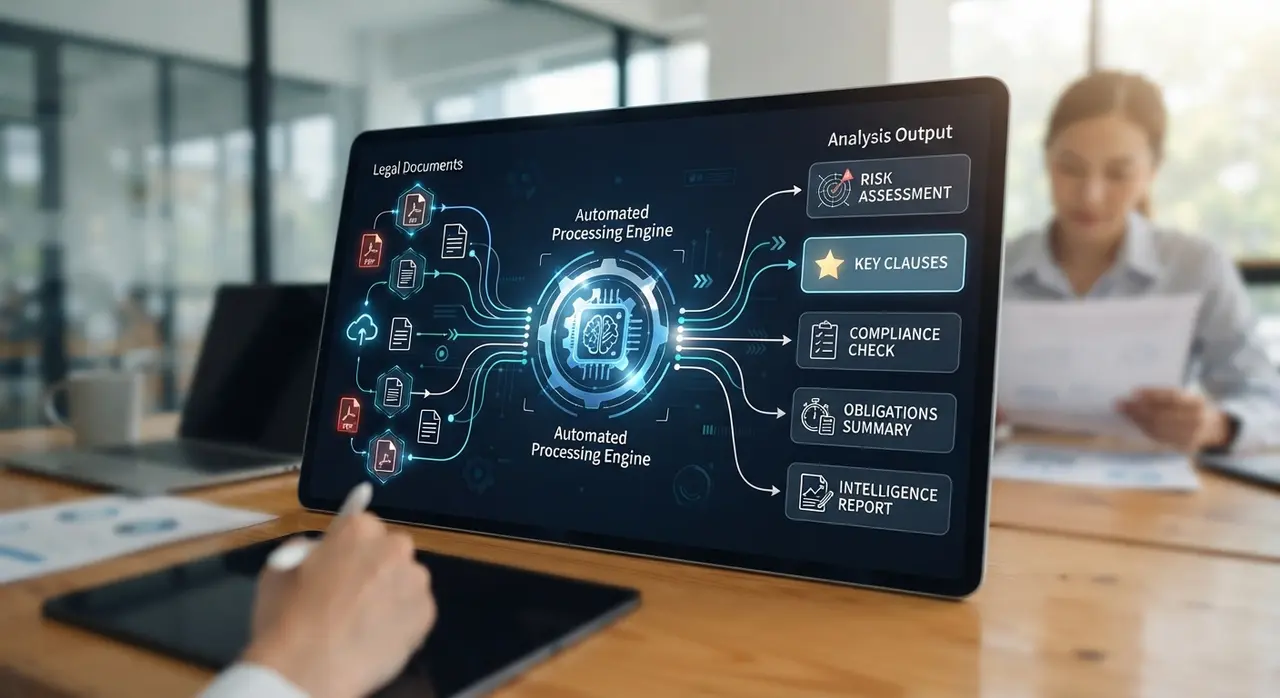
An automated contract review workflow transforms unstructured legal text into structured risk summaries through a three-stage pipeline of ingestion, analysis, and signaling. When a law firm receives a contract, the digital document is ingested into the system where optical character recognition (OCR) and natural language processing engines read every page.
During the identification phase, the AI agent parses complex sentence structures against pre-configured firm playbooks. It categorizes clauses into standard legal domains such as governing law, limitation of liability, indemnification, intellectual property rights, and confidentiality obligations.
Finally, the signaling phase generates an executive summary for the legal team. Instead of forcing an attorney to read 80 pages of boilerplates from scratch, the system presents an annotated dashboard highlighting non-standard language, missing protective clauses, and severe legal liabilities.
The Essential Role of Generative AI and n8n Integration
Integrating advanced generative AI (ia generativa) models with flexible workflow orchestrators enables seamless data parsing between law firm document repositories and specialized analysis engines. Modern legal practices frequently ask n8n o que é (what is n8n) when designing custom automation stacks. In technical terms, n8n is an enterprise-grade workflow automation tool that connects firm storage platforms like Google Drive or OneDrive directly to generative AI models and practice management systems without compromising client confidentiality.
By deploying n8n orchestration, law firms build private pipelines that send contract text securely through encryption protocols. The generative AI model receives structured instructions based on the firm's specific legal strategy, ensuring that proprietary contract standards remain consistent across all incoming corporate files. Recognizing these workflow operational upgrades is one of the key signs your law firm is ready for AI adoption in today's fast-paced corporate market.

Key Risk Categories AI Agents Detect in Legal Contracts
AI contract agents systematically flag non-standard liability caps, restrictive indemnification, rogue termination terms, and compliance gaps across high-volume agreements. By comparing incoming contract language against pre-established internal thresholds, the agent instantly surfaces anomalies that might take human eyes hours to detect.
| Contract Section | Standard Baseline | AI Identified Risk Flag | Operational Impact |
|---|---|---|---|
| Limitation of Liability | Capped at 1x contract value | Uncapped liability or unlimited indirect damages | Exposes client to catastrophic monetary exposure |
| Indemnification | Mutual indemnification for third-party claims | Unilateral client obligation covering general negligence | Forces unfair risk absorption onto client |
| Termination for Convenience | 30 to 60 days written notice | Immediate termination without notice or fee penalty | Creates operational instability and cash flow risk |
| Governing Law & Venue | Local state/federal jurisdiction | Foreign or unfavorable arbitration forums | Dramatically increases potential litigation costs |
| Data Privacy & Security | Standard GDPR/LGPD compliance requirements | Absence of mandatory data breach notification clauses | Triggers regulatory fines and compliance breach |
Human Oversight: Why AI Is an Assistant, Not a Decision-Maker
Artificial intelligence serves strictly as an analytical virtual assistant (assistente virtual) to highlight potential issues, leaving strategic legal reasoning and final drafting to qualified attorneys. AI tools do not render legal advice, interpret subtle judicial trends, or decide commercial risk tolerance for a client.
Mandatory human review remains the legal and ethical foundation of legal tech implementation. The contract agent highlights suspicious language and recommends revisions based on past firm precedents, but the managing attorney approves every edit and negotiates final terms with opposing counsel.
Mini Case Study: M&A Due Diligence Acceleration
A medium-sized corporate law firm specializing in mid-market mergers and acquisitions faced a critical bottleneck during a multi-company due diligence phase. The legal team needed to analyze over 180 vendor and licensing agreements within a tight ten-day window.
By implementing custom AI solutions for law firms developed by IAChatbot, the practice routed all incoming PDFs through an automated risk-scanning agent. The AI agent pre-screened all 180 agreements, flagged 24 non-compliant change-of-control clauses, and compiled a comprehensive executive risk report in under 12 hours. The managing partners focused their limited review hours exclusively on high-risk files, completing the due diligence audit four days ahead of schedule with zero missed liabilities.
Frequently asked questions
What is an AI agent for contract analysis?
An AI agent for contract analysis is an automated software tool that uses artificial intelligence to scan legal documents, identify key clauses, and flag potential commercial or regulatory risks. It produces quick risk summaries to assist legal teams during document review.
Can generative AI replace legal review by a human lawyer?
No, generative AI cannot replace human attorneys because it lacks legal reasoning, professional ethics, and contextual strategic judgement. AI operates as a support assistant that accelerates reading and flagging, but final legal verification is mandatory.
Is client data secure when using contract analysis AI agents?
Yes, enterprise AI deployment workflows utilize dedicated API connections and end-to-end encryption pipelines that prevent client contracts from being shared with public training models. Data security protocols match standard legal industry compliance frameworks.
How long does it take to train an AI model on law firm contract standards?
Setting up a customized contract analysis agent requires defining the law firm's specific playbook and risk thresholds, which typically takes only a few business days. The system uses pre-trained legal models connected directly to your custom guidelines.