
AI in Tourism Myths: Elevate Customer Experience Now
Discover the AI in tourism myths holding your travel agency back. Learn how the WhatsApp Business API improves customer experience and customer support.
- AI in Tourism
- Travel Agency Automation
- Customer Experience
- WhatsApp API
- Business Growth

The Invisible Barrier Holding Your Travel Agency Back
Are you a travel agency owner or manager feeling left behind in the digital race? You are not alone. The travel industry is evolving at breakneck speed, and Artificial Intelligence is leading the charge.
However, hesitation is natural. You have likely heard countless rumors about AI. These rumors build an invisible barrier, paralyzing your growth and keeping your team bogged down in repetitive tasks.
It is time to tackle the AI in tourism myths head-on. The truth is, adopting AI is not about replacing your dedicated team. It is about revolutionizing your customer experience and scaling your operations seamlessly.
Let's dismantle the most common misconceptions and reveal how modern technology, like the WhatsApp Business API, can turn your boutique agency into a highly efficient, 24/7 booking machine.
Myth 1: "AI Will Replace Human Travel Agents"
This is the most pervasive fear in the industry. Many agents believe that bringing AI into the office is equivalent to handing over their jobs to a robot. They argue that travel is deeply personal and requires a human touch.
The Reality: AI Empowers, Humans Advise
Travel is personal. But answering "What is the baggage allowance for my flight?" for the tenth time today is not personal; it is purely administrative. AI excels at handling these repetitive, high-volume inquiries.
When you automate the mundane, you free up your team's most valuable asset: their time. Instead of acting as data entry clerks, your staff transforms into true travel advisors.
- Focus on complex itineraries: Agents can spend time crafting bespoke honeymoons or intricate multi-city corporate trips.
- Build stronger relationships: More time for face-to-face or voice-to-voice consultations.
- Reduce burnout: Your team leaves work feeling accomplished, not exhausted from answering FAQs.
AI handles the operational heavy lifting, while the human agent provides the empathy, negotiation skills, and subjective recommendations that machines simply cannot replicate.
Myth 2: "AI is Too Expensive for Small Agencies"
For a long time, advanced technology was a luxury reserved for massive corporations with Silicon Valley budgets. Small and mid-sized travel agencies naturally assumed that AI implementation would drain their limited resources.
The Reality: High ROI and Accessible Tech
This myth is entirely outdated. Today, AI solutions are highly democratized and accessible via flexible, subscription-based models. You do not need to hire a team of developers or build proprietary software from scratch.
Integrating the WhatsApp Business API, for example, is surprisingly affordable. You pay for actual usage, allowing you to scale your costs perfectly in sync with your business growth.
Consider the return on investment (ROI). If an AI assistant can qualify leads outside of business hours, capture contact information, and prevent potential clients from going to a competitor, the system pays for itself almost immediately.
Myth 3: "Travelers Only Want to Talk to Humans"
Agency owners often take pride in their personalized service. They assume that if a client reaches out, they want to hear a human voice or read a human-typed email, regardless of the situation.
The Reality: Speed First, Human Touch Second
Yes, clients want human interaction when they are brainstorming a luxury safari or resolving a major travel disruption. But what about a quick question about flight times at 2 AM? Or a request for a hotel voucher copy?
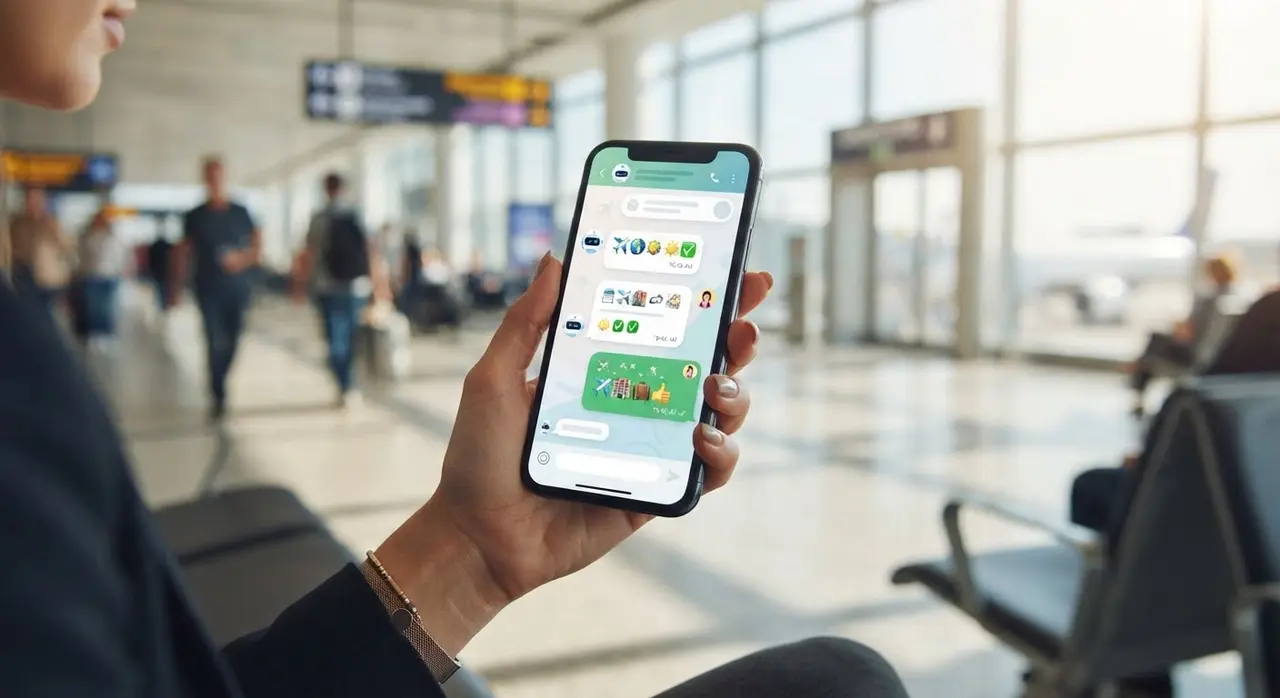
In these moments, travelers prioritize speed and convenience over human interaction. Superior customer support means being there exactly when they need you, with the exact information they requested.
AI delivers instant gratification. A well-designed chatbot can instantly retrieve booking details, send boarding passes, or clarify visa requirements within seconds. If the query gets too complex, the AI seamlessly transfers the chat to a human agent, along with the full context of the conversation.
Myth 4: "AI is Only for Giant OTAs (Online Travel Agencies)"
It is easy to look at giants like Booking.com or Expedia and think, "Of course they use AI, they have endless resources." This leads small agencies to believe that automation is a corporate tool, incompatible with boutique services.
The Reality: Leveling the Playing Field for SMBs
AI is actually the ultimate equalizer. It allows a small team of three or four agents to offer the same 24/7 responsiveness as a massive OTA. You can provide round-the-clock service without hiring a night shift.
Small agencies are actually in a better position to leverage AI. You can implement changes faster, without the bureaucratic red tape that slows down large corporations. You can train your AI to reflect your unique brand voice—whether that is casual and adventurous or refined and luxurious.
Want to see how this works in practice? Check out these 7 ways AI closes more travel packages for agencies of any size.
How AI Actually Transforms Your Travel Agency
To truly understand the impact, we need to compare the traditional way of running a travel agency with an AI-powered approach. The difference in efficiency and customer experience is staggering.
| Process | Traditional Agency | AI-Powered Agency |
|---|---|---|
| Lead Qualification | Agents spend hours asking basic budget and date questions. | AI asks qualifying questions instantly via WhatsApp. |
| Customer Support | Available only 9 AM to 6 PM. Slow response times. | 24/7 instant answers for FAQs and document retrieval. |
| Quoting | Manual data entry, prone to human error and delays. | Automated data extraction and instant preliminary quotes. |
| Post-Sales | Often forgotten due to lack of time. | Automated check-ins and review requests. |
As the table shows, AI does not remove the agent; it optimizes the workflow. It ensures that every lead is captured and every client feels valued, regardless of the time of day.
Real-World Application: The Small Agency Advantage
Let's look at a practical example. Imagine a boutique agency specializing in European river cruises. Before AI, their lead conversion was struggling because potential clients were browsing their site on Sunday evenings and sending inquiries via Instagram and WhatsApp.

By Monday morning, the agents were overwhelmed with messages. The delay in response meant many leads had already booked elsewhere. The agency was losing money simply because they could not reply fast enough.
The Turnaround
They integrated an AI agent connected to their WhatsApp API. Now, when a client messages on a Sunday night, the AI instantly replies.
- It asks for the preferred travel dates.
- It inquires about the number of travelers and budget.
- It provides a brief, engaging overview of popular cruise routes.
By Monday morning, the human agents open their dashboard to find perfectly qualified, warm leads. They can immediately start crafting personalized proposals instead of playing phone tag. You can explore more examples of use to see how AI handles various customer inquiries across different scenarios.
The Cost of Inaction in a Digital World
While busting myths is crucial, it is equally important to understand the risk of doing nothing. The travel industry is highly competitive. If your agency insists on manual processes, you are inadvertently choosing to operate at a disadvantage.
Travelers today expect seamless digital experiences. If they have to wait 24 hours for a simple itinerary update, they will look for an agency that can provide it instantly. Implementing AI is no longer just an innovative upgrade; it is becoming a baseline expectation for modern customer support.
Furthermore, post-trip follow-ups are crucial for retention. An AI agent for post-sales can automatically collect reviews, handle minor complaints, and encourage referrals without adding a single task to your team's to-do list.
Embracing the Future of Travel
The myths surrounding AI in tourism are just that—myths. They are born from a misunderstanding of what the technology is designed to do. AI is a tool, much like a global distribution system (GDS) or a CRM. It is meant to be wielded by skilled professionals to enhance their capabilities.
By automating the mundane, you elevate the human element of your business. You provide faster answers, better support, and more personalized advice. Do not let outdated fears stall your agency's potential. The future of travel belongs to those who combine the efficiency of AI with the irreplaceable warmth of human hospitality.
Frequently Asked Questions
How hard is it to integrate AI with my current system?
It is much easier than you think. Modern AI solutions, especially those utilizing the WhatsApp Business API, are designed to integrate smoothly with most standard CRMs and booking platforms. You don't need coding knowledge; a specialized provider will handle the technical setup and workflow automation for you.
Will the AI sound robotic and alienate my clients?
Not at all. Today's AI uses advanced natural language processing. You can train the AI agent to adopt your agency's specific tone of voice—whether it is formal, enthusiastic, or relaxed. To the client, it often feels like they are texting a highly efficient, polite assistant.
Can AI handle complex custom itineraries?
AI is best used for the initial stages of a complex itinerary—gathering basic requirements, budget constraints, and destination preferences. Once the foundational data is collected, the AI hands the conversation over to a human travel expert who will curate and finalize the bespoke details.
Is my clients' data safe with an AI chatbot?
Yes. Reputable AI providers use enterprise-grade encryption and comply with data protection regulations (like GDPR or LGPD). Data handled through official channels like the WhatsApp API is encrypted, ensuring your clients' personal information remains secure and confidential.