
Criar Chatbot: AI Agent for Travel Visas & Passports
Discover how an AI documentation agent answers visa and passport queries, prevents boarding issues, and streamlines your travel agency customer service.
- Travel Agency AI
- Customer Service Bot
- Visa Automation
- Travel Technology
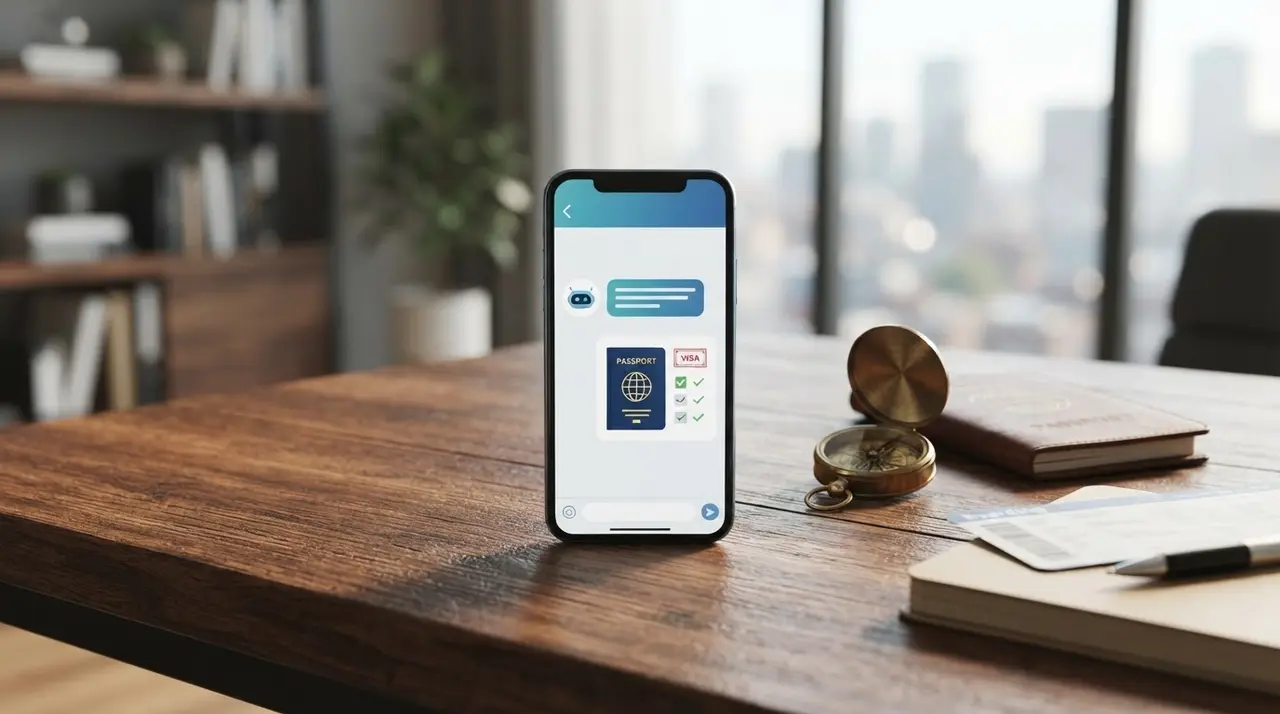
An AI documentation agent is a specialized bot de atendimento that instantly informs travelers about visa requirements, passport validity, and specific destination rules. By choosing to criar chatbot solutions for documentation, travel agencies prevent costly boarding denials and free up human agents for complex sales. Travel rules change constantly, and keeping clients updated manually is a heavy operational burden.
For small and medium-sized travel agencies, repetitive questions about baggage limits, vaccine mandates, and passport expiration dates consume hours of valuable time. An AI assistant acts as a first line of defense. It cross-references the traveler's destination with an updated knowledge base, delivering precise answers in seconds.
Instead of waiting for an agent to reply, the client receives immediate guidance on WhatsApp or the agency's website. If a case requires human judgment—such as a previous visa denial or dual citizenship—the AI seamlessly transfers the conversation to a specialized consultant, ensuring no traveler is left without support.
A documentation AI agent prevents costly boarding denials
A documentation AI agent prevents costly boarding denials by proactively alerting clients about passport expiration dates and required travel authorizations. One of the most common nightmares in the travel industry is a client arriving at the airport only to discover their passport expires in three months, while the destination country requires a minimum of six months of validity.
When an agency uses AI, the system can automatically send a checklist weeks before the departure date. It asks the traveler to confirm their passport's expiration date and checks if specific electronic authorizations, like the upcoming European ETIAS or the US ESTA, have been secured.
This proactive approach eliminates the "I didn't know" scenario. By automating these reminders, you protect your agency from negative reviews and liability claims, while providing a premium, concierge-level experience to your customers.

Furthermore, the AI can filter requirements based on the traveler's nationality. A simple prompt like, "I am traveling to Japan with a Brazilian passport," triggers the bot to pull the exact entry rules for that specific combination, removing the guesswork for both the client and the travel agent.
Building the knowledge base for destination requirements
Building the knowledge base for destination requirements ensures your AI delivers accurate, up-to-date, and reliable information to every traveler. An AI is only as smart as the data it accesses. For a travel documentation bot, this means integrating official government guidelines, IATA travel center data, and your agency's internal manuals.
To maintain high accuracy, agencies must structure their data logically. Instead of feeding the AI generic internet articles, upload official PDF guides, consulate links, and structured FAQs. The bot uses Natural Language Processing (NLP) to read these documents and extract the exact answer a client needs.
- General Requirements: The bot explains standard rules, such as Schengen area insurance mandates or yellow fever vaccine certificates.
- Deadlines and Processing Times: It sets clear expectations, informing clients that a specific consulate might take 45 days to process a visa request.
- Required Documents: It provides bulleted lists of necessary paperwork, such as bank statements, employment letters, and accommodation proofs.
Updating this knowledge base is straightforward. When a country changes its entry rules, you simply upload the new guideline document to the AI platform. The bot instantly adapts its answers, ensuring your team never accidentally gives outdated advice.
Recognizing limits and escalating complex visa cases
Recognizing limits and escalating complex visa cases guarantees that high-stakes documentation issues are handled by experienced human professionals. While AI is fantastic for standard queries, immigration laws can be incredibly nuanced. The bot is programmed to identify "red flag" keywords or complex scenarios and immediately route them to a human agent.
For instance, if a client asks, "Can I travel to the US if I overstayed my previous visa?" the AI will not attempt to give legal immigration advice. Instead, it responds with a polite holding message and tags a senior consultant to take over the chat. This hybrid approach balances efficiency with safety.
The handoff process includes the entire chat history. When the human agent steps in, they already know the client's destination, passport type, and specific concern. This eliminates the frustration of forcing the customer to repeat themselves.
Integrating systems for seamless traveler support
Integrating systems for seamless traveler support ensures that your AI assistant has real-time access to client itineraries and billing information. A standalone bot is useful, but an integrated bot is a game-changer. By connecting your AI to your CRM and booking systems, you create a personalized experience.
For example, if your agency handles corporate travel, you might integrate the bot with financial software using an api ixc to manage billing inquiries alongside travel requirements. This means a corporate client can ask about their visa status and their latest invoice in the same WhatsApp conversation.
Connecting to platforms like Amadeus or Sabre allows the bot to pull the exact flight dates and cross-reference them with visa processing times. If you want to learn more about how system integrations drive revenue, check out our guide on 7 Ways AI Closes More Travel Packages.

Comparing manual support versus an AI documentation agent
Comparing manual support versus an AI documentation agent highlights the massive operational efficiency gained through automation. Human agents are brilliant at sales and empathy, but they are expensive and slow when acting as simple search engines for visa rules.
Below is a breakdown of how an AI assistant transforms the daily operations of a travel agency compared to traditional manual support:
| Feature | Manual Support | AI Agent |
|---|---|---|
| Response Time | Minutes to hours | Instant (under 2 seconds) |
| Availability | Business hours only | 24/7, including holidays |
| Accuracy on Rules | Prone to human memory errors | 100% based on uploaded data |
| Scalability | Requires hiring more staff | Handles unlimited simultaneous chats |
| Focus | Stuck on repetitive questions | Focused on complex cases and sales |
By shifting the burden of repetitive questions to the AI, your team can focus on upselling travel insurance, booking luxury excursions, and providing emotional reassurance to anxious travelers.
Mini-case: Reducing repetitive queries at a mid-sized agency
Using IAChatbot, a mid-sized travel agency recently transformed its pre-boarding operations and drastically reduced support tickets. Before adopting AI, their team spent roughly 30% of their day answering the exact same questions about European travel requirements and passport validities.
They implemented an IAChatbot assistant specifically trained on their top 20 destinations. The bot was deployed on WhatsApp and their website. Within the first two months, the agency saw a 70% drop in repetitive documentation questions reaching their human agents.
More importantly, the bot successfully flagged three cases where clients had passports expiring in less than six months. By catching these issues weeks before departure, the agency prevented guaranteed boarding denials, saving the clients thousands of dollars and preserving the agency's reputation. You can explore more AI use cases to see how this technology adapts to different business needs.
Step-by-step guide to deploy your travel AI assistant
Deploying a travel AI assistant requires a strategic approach to ensure it genuinely adds value to your clients' journey. The technology is accessible, but the execution determines its success. Start by mapping out the most common documentation questions your team receives daily.
- Gather your official documents: Collect PDF guides, links to consulate websites, and your internal FAQ documents.
- Choose the right platform: Select an AI platform that integrates easily with WhatsApp and your CRM.
- Train the bot: Upload your documents and test the bot with complex questions to ensure it retrieves the right answers.
- Define escalation rules: Program the bot to hand over the chat to a human whenever words like "denied," "deported," or "expired" are mentioned.
- Launch and monitor: Roll out the bot to a small segment of clients first, monitor the conversations, and refine the knowledge base based on real interactions.
By following these steps, your agency will not only modernize its customer service but also build a robust safety net against documentation errors. Embracing AI is no longer just an innovation; it is a necessity for travel agencies that want to scale securely and profitably.
Frequently asked questions
Can the AI agent apply for the visa on behalf of the client?
No, the AI agent cannot legally apply for visas or fill out government forms on behalf of the traveler. Its role is strictly informational, guiding the client on where to apply, what documents to gather, and the expected processing times.
How does the bot handle rules that change overnight?
The AI relies on the knowledge base you provide. If a country suddenly changes its entry rules, you must upload the new official guidelines into the system. Once updated, the bot instantly applies the new rules to all future conversations.
What happens if the AI gives the wrong information?
To prevent errors, the AI is restricted to answering only based on the documents you upload, preventing it from "hallucinating" answers. However, as a safety measure, agencies should always include a disclaimer stating that travelers must verify final requirements with official consulates.
Does the bot work for corporate and leisure travel alike?
Yes, the AI can be customized to handle both profiles. For leisure travelers, it focuses on standard tourist visas, while for corporate clients, it can be trained on business visa requirements and integrated with corporate billing systems.