
AI ERP Integration for Real-Time Inventory Automation
Stop losing sales to stockouts. Learn how AI ERP integration brings real-time inventory automation to your store, improving construction material quotes.
- Inventory Automation
- Hardware Store AI
- ERP Integration
- Retail Technology
- Sales Automation

The Hidden Cost of Phantom Inventory
Selling a product you don't actually have in stock is a nightmare. You close the deal, take the customer's money, and then have to make the dreaded phone call to apologize.
For independent hardware stores and paint shops, phantom inventory destroys trust and kills repeat business. When your physical shelves don't match your system, everyone loses.
That's where inventory automation steps in. By integrating Artificial Intelligence directly into your existing ERP system, you can guarantee that what you sell is exactly what you have.
Let's explore how AI transforms your stock control from a reactive guessing game into a proactive, real-time profit engine.
What is Real-Time Inventory Automation?
Traditional ERP systems are essentially digital filing cabinets. They only know what human operators tell them. If a clerk forgets to log a damaged product or a returned item, the system becomes outdated.
Integrating AI into your ERP changes the dynamic. The AI acts as an active digital assistant that continuously reads data, monitors sales velocity, and flags inconsistencies before they affect your customers.
Continuous Quantity Tracking
An AI-powered system doesn't wait for end-of-day batch processing. Every time a customer messages your WhatsApp asking for a product, the AI queries the ERP in milliseconds.
If a specific item is low in stock, the AI knows immediately. It ensures your sales team—and your automated chatbots—only offer products that are physically available on the shelf.

Smart Reorder Alerts
Running out of best-sellers is just as bad as phantom stock. AI analyzes your historical sales data, seasonality, and current stock levels to predict exactly when you will run out.
Instead of manually checking shelves, managers receive automated alerts. The AI calculates the ideal reorder point, ensuring you replenish your stock just in time without tying up excess capital.
Managing Your Paint Catalog with AI
Paint shops face a unique challenge: managing thousands of variations. Different brands, finishes, bases, and colors create a highly complex matrix.
Keeping a manual track of an extensive paint catalog is nearly impossible. A customer might ask for five gallons of matte white acrylic paint, but your system only shows stock for the semi-gloss version.
When AI integrates with your ERP, it instantly navigates this complex catalog. If a customer requests a specific color on WhatsApp, the AI can:
- Check the exact stock of the required base paint.
- Verify if the colorants needed are available.
- Suggest an alternative finish or brand if the requested item is out of stock.
This level of intelligence prevents cart abandonment and ensures your customer gets a viable solution instantly, directly through their smartphone.
Generating a Flawless Construction Material Quote
Contractors and builders don't have time to wait days for pricing. They send a list of materials and expect a fast, accurate response.
Creating a manual construction material quote is slow and prone to human error. Sales reps often quote outdated prices or include items that are no longer in stock.
With AI connected to your ERP, this process becomes frictionless. The customer sends their material list via WhatsApp. The AI reads the request, queries the ERP for current prices and real-time availability, and generates a formatted, professional quote in seconds.
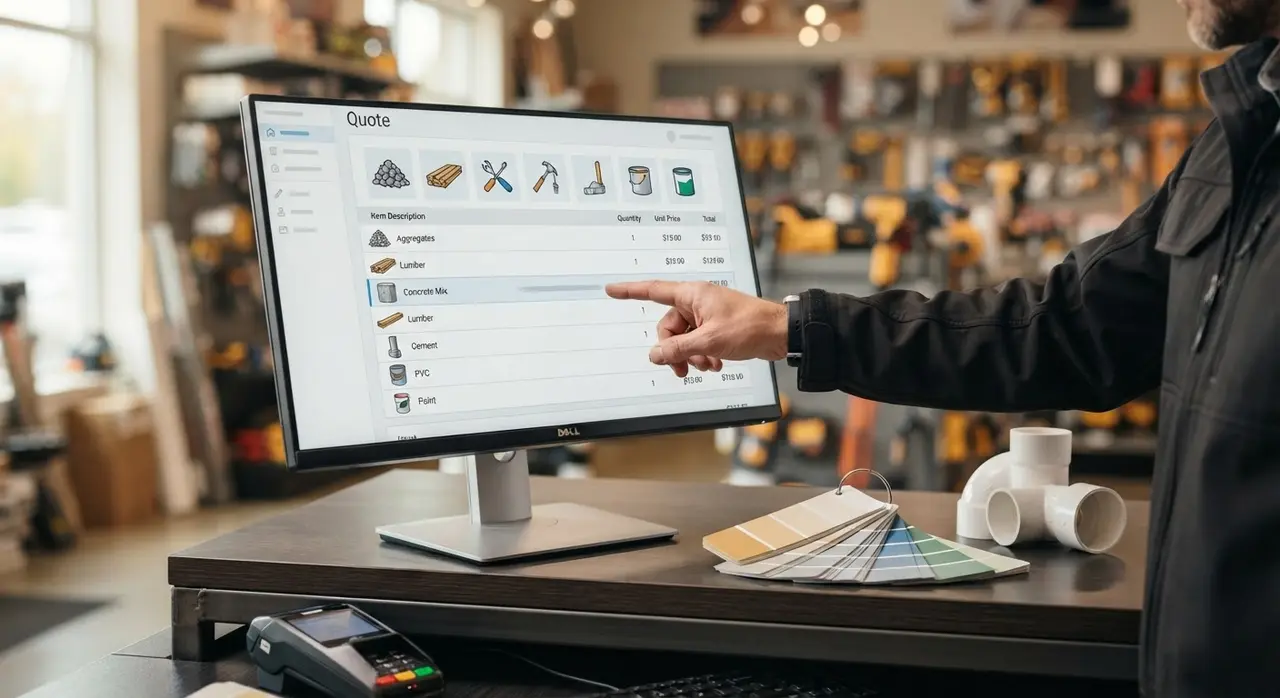
If an item is missing, the AI automatically suggests an equivalent substitute. This means your sales team spends less time digging through spreadsheets and more time closing high-value deals.
How the AI-ERP Data Flow Works
Understanding the technical flow can help you see the value of this integration. It is simpler than it sounds, operating in a continuous, seamless loop.
| Step | Action | Result |
|---|---|---|
| 1. Customer Inquiry | Customer requests a product via WhatsApp or in-store. | AI instantly receives the request. |
| 2. ERP Query | AI pings the ERP database for real-time stock and pricing. | Accurate data is retrieved in milliseconds. |
| 3. Logic Application | AI checks for reorder points, substitutes, and active promotions. | The best possible offer is formulated. |
| 4. Customer Response | AI replies to the customer with availability or a complete quote. | Customer gets immediate, reliable service. |
This automated flow eliminates the bottleneck of human intervention for routine checks. It is one of the biggest reasons why upgrading your operations is crucial. If you are wondering if it is time to upgrade, check out the 5 signs your hardware store is ready for AI adoption.
Actionable Steps to Get Started
Integrating AI into your ERP doesn't mean ripping out your current software. Modern AI solutions work alongside your existing tools via API connections.
- Audit your current ERP: Ensure your system has an open API or export capabilities. Most modern systems do.
- Clean your data: AI is only as good as the data it reads. Make sure your product codes, barcodes, and descriptions are standardized.
- Define your rules: Tell the AI what your minimum stock levels are and which products can be used as substitutes.
- Deploy gradually: Start by automating quotes for your top 50 selling items before rolling it out to your entire inventory.
By taking these steps, you protect your margins, empower your sales team, and provide a world-class buying experience for your customers. To see more practical applications, explore our AI use cases in customer service.
Frequently Asked Questions
Do I need to change my current ERP to use AI?
No. Most modern AI solutions, including those provided by IAChatbot, connect to your existing ERP through APIs. The AI acts as a layer on top of your current software, reading and updating data without requiring a system overhaul.
How does the AI handle unrecorded damaged or stolen goods?
While AI is incredibly smart, it cannot physically see your shelves. Regular cycle counts are still necessary. However, AI can flag suspicious sales patterns or items that haven't moved in a long time, prompting your team to do a manual check on specific aisles.
Can the AI really create quotes for complex construction projects?
Yes. By mapping your product catalog and defining rules for complementary items, the AI can instantly read a list of requested materials sent by a customer and generate a precise quote based on your live ERP pricing and stock availability.
Is this technology only for large retail chains?
Not at all. AI integration has become highly accessible. Small and medium-sized independent hardware stores are using AI to compete with big-box retailers by offering faster, more personalized service on platforms like WhatsApp.