
Cut Counter Service Costs with AI in Retail Stores
Learn how paint and hardware stores cut counter service costs using AI automation, instant WhatsApp quotes, and ERP integrations like Linx Microvix API.
- AI Automation
- Paint Store Management
- Hardware Retail
- Linx Microvix API
- Customer Service
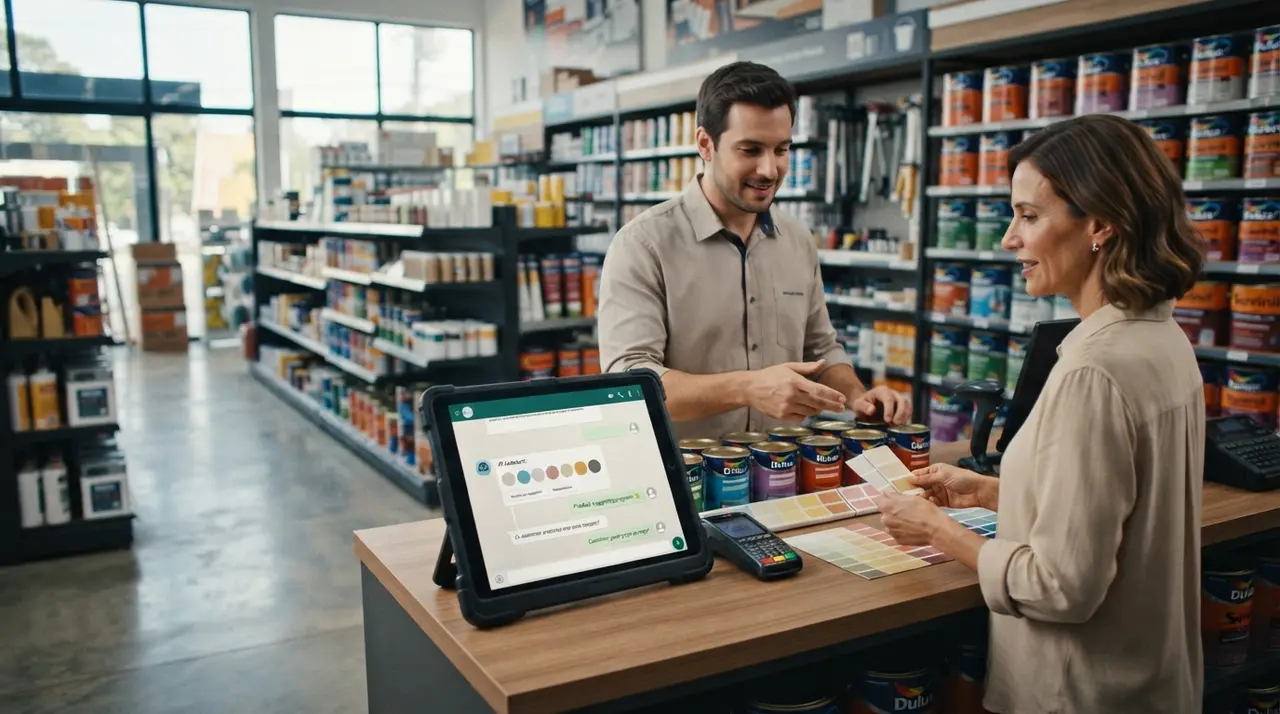
Reducing counter service costs with artificial intelligence requires automating high-volume inquiries like stock checks, product specifications, and price quotes before customers reach physical sales staff. By deploying conversational AI agents on WhatsApp, paint and construction material retailers offload up to 70% of repetitive counter interactions while keeping sales reps focused on high-margin consultations.
In traditional paint and hardware retail, the sales counter serves as both a customer service hub and a bottleneck. Frontline staff spend hours answering basic queries, calculating material quantities, and looking up product availability in inventory systems. When a customer walks in or calls to ask basic technical details, expensive human labour is tied up in low-value routine tasks.
By integrating intelligent virtual assistants into daily retail operations, independent store owners transform how incoming requests are processed. Rather than creating physical lines at the desk or placing phone callers on hold, an automated agent screens requests, calculates estimates, and reserves products automatically.
The Hidden Cost Breakdown of Manual Counter Service
Manual counter service carries significant labor overhead because sales specialists spend the majority of their paid hours on low-value administrative tasks. When evaluating the hourly cost of a counter salesperson, store owners must account for base salary, benefits, training, and lost sales opportunities caused by delayed service.
In a standard paint or hardware store, counter cost drivers fall into four main categories:
- Repetitive Price Inquiries: Sales reps spend several minutes searching inventory systems just to provide single item pricing.
- Technical Guidance Bottlenecks: Customers frequently need advice on how to choose paint finish, washability, or wall primers, tying up senior technicians for 15 to 20 minutes per inquiry.
- Queue Friction: Long waiting lines during peak hours force time-sensitive contractors and retail buyers to abandon purchases and visit competitors.
- Manual Order Entry: Copying customer data from handwritten slips or WhatsApp messages into the store management software creates human errors and slows down fulfillment.
When experienced team members are constantly interrupted to answer routine inventory questions, their capacity to close complex, high-ticket contractor quotes drops dramatically. Store owners can evaluate their operational readiness for automated workflows by reviewing the 5 signs your hardware store is ready for AI adoption.
Automating Technical Advice and Product Selection
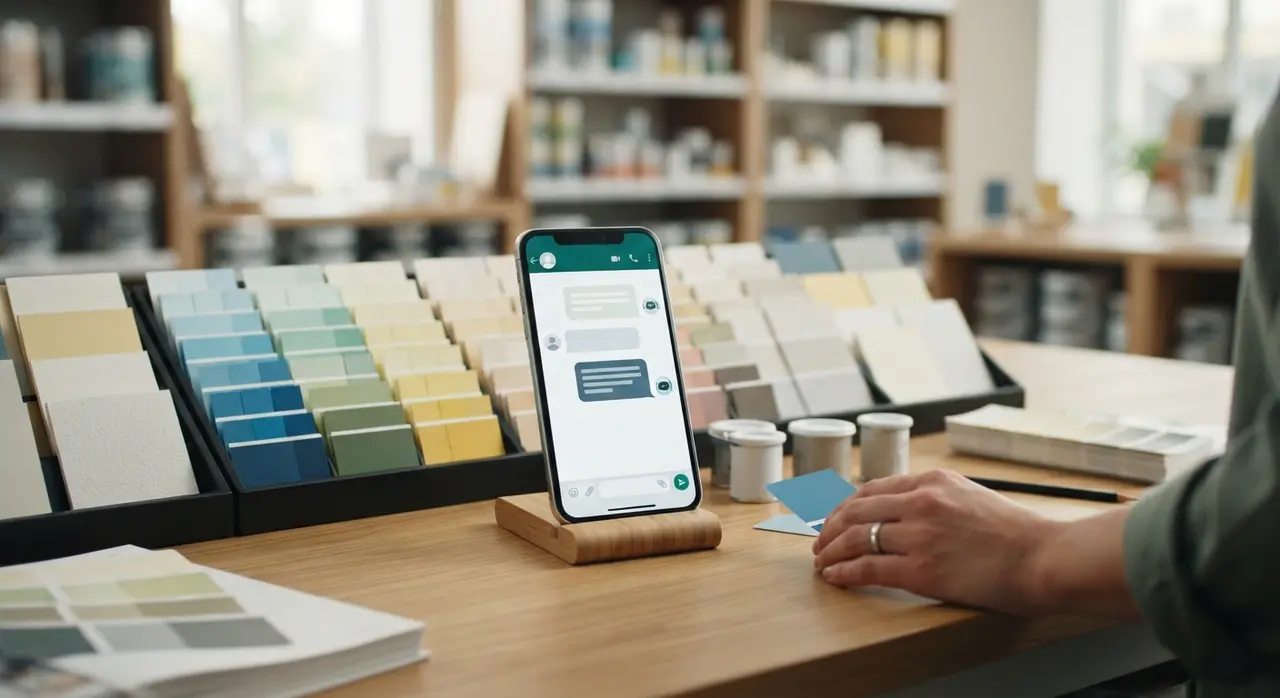
Artificial intelligence guides retail customers through complex technical choices by instantly matching surface requirements with the correct product formulations. Instead of waiting at the counter to consult a specialist, shoppers can interact with a WhatsApp AI assistant that asks structured qualifying questions.
For instance, when a homeowner asks how to choose paint for a high-moisture bathroom or an outdoor concrete wall, the AI evaluates factors such as exposure, surface porosity, and desired finish. It then recommends the exact primer, paint line, and application tools needed for the job.
This automated guidance delivers several immediate operational advantages:
- Pre-qualified Inquiries: Customers arrive at the payment counter knowing precisely which products they need, reducing consultation time from 15 minutes to under 2 minutes.
- Consistent Technical Accuracy: The AI draws directly from manufacturer technical sheets, eliminating staff guesswork regarding coverage ratios or drying times.
- Automated Upselling: The system consistently suggests mandatory accessories—such as painters tape, rollers, and sand paper—with every recommendation.
Integrating Inventory Management via Linx Microvix API
Seamless ERP connectivity eliminates manual stock checks by giving conversational AI agents live access to inventory databases. Integrating your AI assistant with platforms like the linx microvix api allows the system to check stock across multiple store locations and tinting bases in milliseconds.
When a client requests a quote for 50 liters of exterior acrylic paint in a specific tint, the AI queries the ERP system via API to verify base availability, calculates the required pigment additions, and returns an accurate price instantly. If stock is low at the main counter, the assistant can query satellite warehouses automatically.
By leveraging direct system integration through IAChatbot solutions, retail management removes human error from price quotes and stock verification. Sales reps no longer need to leave the customer waiting at the counter while they walk to the backroom to check shelf inventory.
Centralizing Customer Service Across Counters and Digital Channels
Unified AI workflows eliminate channel silos by connecting counter service desks directly to a digital call center hub. When incoming customer messages from WhatsApp, website forms, and phone calls are managed under a central platform, store staff gain full visibility into customer history.
In a typical retail scenario, a painter might request a quote via WhatsApp in the morning. When they arrive at the physical counter later that afternoon, any clerk can pull up the saved digital quote using their central dashboard and complete the sale instantly.
Real-World Impact: Case Study in Retail Optimization
A mid-sized regional building materials supplier facing severe counter congestion during peak morning hours implemented an automated WhatsApp assistant developed by IAChatbot. Prior to implementation, counter staff handled over 180 phone calls daily regarding stock checks, forcing in-store customers to wait in long lines.
By connecting the AI agent directly to their backend ERP, the business automated 72% of preliminary inquiries, order status updates, and price requests. Physical queue times dropped by more than half, allowing existing counter personnel to handle higher sales volumes while significantly improving customer satisfaction scores.

Calculating the Financial ROI: Traditional vs. AI-Filtered Counters
Deploying AI to filter routine service requests drastically lowers the average operational cost per customer interaction. Comparing standard counter labor costs against an automated hybrid model demonstrates clear operational efficiencies.
| Metric / Operational Area | Traditional Counter Model | AI-Assisted Counter Model |
|---|---|---|
| Average Handling Time per Routine Query | 6 to 10 minutes (Human clerk) | Under 10 seconds (Automated) |
| Cost per Price / Stock Query | High (Tied to staff hourly wages) | Near Zero (Scalable software cost) |
| Peak Hour Queue Drop-off Rate | 12% - 18% lost walk-outs | Under 3% abandoned interactions |
| Quote Generation Time | 15 - 30 minutes manually | Instant automated delivery |
| Staff Capacity Utilization | 70% absorbed by routine tasks | 80% focused on complex sales |
As shown above, transferring preliminary interactions to a digital assistant turns fixed labor overhead into a flexible, scalable asset. Store managers interested in practical automation setups can explore real-world AI integration examples to review practical architecture diagrams.
Scaling Counter Capacity Without Increasing Payroll
Artificial intelligence enables retail businesses to handle double-digit sales growth without adding administrative headcount to the physical store. When seasonal demand surges, the automated WhatsApp service absorbs the spike in incoming inquiries without requiring overtime pay or temp staff.
By letting virtual agents screen tier-1 questions, your physical sales team transforms from transactional order-takers into high-value product advisors. This operational shift directly improves gross margins while establishing a modern, responsive brand image across both digital and physical retail touchpoints.
Frequently asked questions
How long does it take to integrate AI with our existing retail ERP system?
Most standard ERP integrations using modern REST APIs can be deployed within 1 to 3 weeks depending on system customization. Once configured, the AI reads live stock levels and pricing tables automatically without requiring manual data uploads.
Can the AI assistant accurately handle complex paint tinting and measurement calculations?
Yes, conversational AI agents can be trained on specific technical rules, square-footage coverage formulas, and tinting base requirements. The system calculates exact paint quantities and recommended coats based on user-provided room dimensions.
What happens when a customer asks a question that the AI cannot answer?
If an inquiry exceeds predefined automated parameters, the system seamlessly hands off the conversation to a human rep at the store counter or call center desk. The clerk receives the full chat transcript, context, and customer details, ensuring a smooth transition without friction.
Is WhatsApp automation suitable for small independent hardware and paint stores?
Yes, small and medium independent retailers often benefit the most because their staff members perform multiple roles simultaneously. Automating routine communication frees up limited personnel to assist walk-in clients, restock shelves, and process orders faster.