
How AI Reads Event Registration Data to Answer Attendees
Discover how AI reads registration data via InEvent API to automate attendee support, badge validation, and accreditation inquiry management.
- Event Automation
- InEvent API
- Accreditation Automation
- AI Chatbots
- WhatsApp AI

Automating Attendee Communications with Real-Time Registration Data
AI event automation (automação de eventos) processes attendee inquiries by dynamically fetching registration records from event management platforms through secure APIs. By interpreting natural language questions, querying live databases via integrations like the InEvent API, and delivering instant answers, conversational AI handles support without manual staff intervention.
For event producers and managers running small to mid-sized operations, managing attendee communication before and during an event represents a major operational bottleneck. Participants frequently inquire about ticket status, accreditation approvals, badge collection points, and session access. When these questions flood messaging channels like WhatsApp, support teams spend hours performing manual database lookups. Integrating conversational artificial intelligence with live event databases transforms customer support into an autonomous, real-time workflow.
The Core Mechanism: How AI Reads Registration Data in Real Time
Real-time registration querying bridges the gap between static attendee databases and conversational messaging channels. Rather than relying on rigid, pre-programmed menu trees, an intelligent assistant acts as an active middleware layer that connects attendee chats directly to event databases.
When an attendee sends a message asking for their ticket details or check-in confirmation, the AI assistant initiates a structured operational flow:
- Natural Language Processing: The system identifies the user's intent and extracts identifying variables such as phone number, email address, or tax ID.
- Database Querying: The AI makes a secure call to the registration platform using dynamic end-points like the inevent api to fetch current record attributes.
- Contextual Data Parsing: The system checks payment confirmation, ticket category, badge printing status, and assigned entry gates.
- Automated Response Generation: The assistant compiles the retrieved data into a concise, user-friendly message sent directly back to the participant.
This closed-loop process ensures that responses are always accurate, personalized, and updated to the exact second the query is placed.
Step 1: Natural Language Interpretation and Intent Recognition
Natural language understanding transforms unstructured chat messages into structured API parameters. Attendees rarely write standardized commands; instead, they send colloquial messages such as "Can I still get my badge?" or "Where is my ticket QR code?"
An advanced AI model breaks down these inputs by isolating core concepts:
- Primary Intent: Requesting check-in credentials, checking registration status, or verifying payment approval.
- Entity Extraction: Identifying unique credentials provided in the message or linked to the sender's WhatsApp account ID.
- Condition Verification: Determining if additional information is required before executing a database query.
If an attendee uses a phone number registered in the main event platform, the AI automatically matches the sender without asking for manual login credentials. To evaluate your organization's readiness for such workflows, explore our analysis on 5 signs your event company is ready for AI adoption.
Step 2: Querying Event Platforms via InEvent API and Webhooks
API integrations enable AI assistants to retrieve live ticket statuses, badge print flags, and session access permissions without delay. Modern management tools expose endpoints that allow external applications to fetch attendee objects instantly.
Through the inevent api or webhooks, the AI platform can query specific database fields instantly:
- Registration State: Confirmed, Pending Payment, Cancelled, or Checked-In.
- Ticket Class: General Admission, VIP, Speaker, Exhibitor, or Press.
- Accreditation Flags: Documentation approved, photo submitted, or badge ready for pickup.
- Access Credentials: Unique alphanumeric code, digital ticket link, or dynamic QR code.
Because the AI queries live endpoints rather than working from static spreadsheet exports, any update made by event organizers is reflected in the conversational channel immediately.
Step 3: Generating Personalized, Context-Aware Responses
Context-aware response generation formats raw API payload data into clear, natural language instructions for attendees. Raw JSON data returned by an API cannot be sent directly to a user; it must be mapped into helpful text.
For instance, if the API returns a status showing that a participant's document is pending validation, the AI generates a specific, actionable response:
"Hello, Alex! We found your registration for the summit. Your ticket is confirmed, but your badge photo is still pending review. Please upload a clear photo here so we can complete your accreditation before arrival."
If the registration is completely verified, the AI delivers the digital ticket instantly alongside check-in guidelines, parking instructions, and venue rules. To review customized implementations, explore our comprehensive range of AI chatbot solutions built for modern service operations.
Automating Check-In and Accreditation Workflows
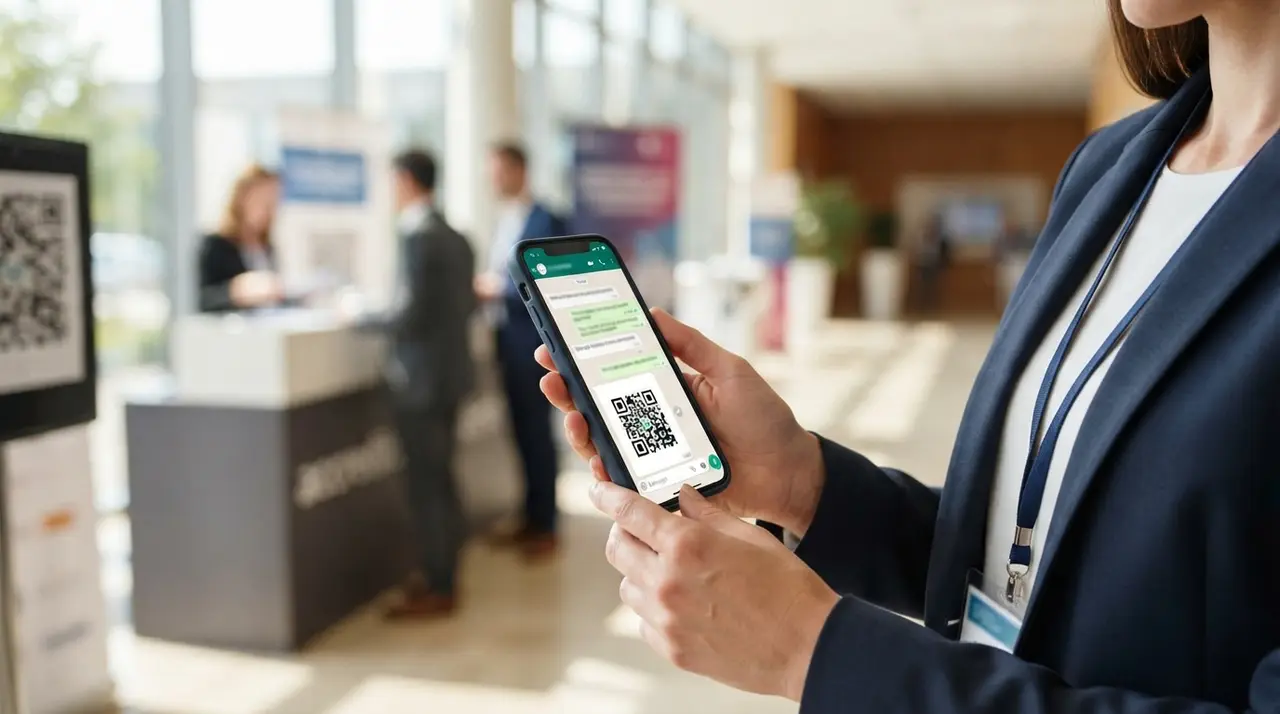
Accreditation automation (automação de credenciamento) eliminates long check-in lines by delivering QR codes and badge status directly via WhatsApp. Physical registration desks during major events are notorious bottlenecks, often caused by participants searching through emails for missing PDF tickets or waiting for staff to manually confirm eligibility.
By automating pre-event accreditation verification, the AI assistant ensures that participants arrive at the venue fully verified:
- Pre-Event Verification: Automated reminders prompt registered attendees to submit missing documentation or confirm attendance prior to the event date.
- Instant Digital Badge Delivery: Verified participants receive a dynamic QR code on their phone, ready to scan at self-service kiosks.
- On-Site Accreditation Guidance: Attendees who require physical badge collection receive real-time instructions regarding designated desk locations based on their ticket tier.
This automated flow keeps entry gates moving efficiently, drastically reducing physical queue management requirements for venue staff.
Comparative Breakdown: Manual Attendee Support vs. API-Driven AI Automation
Comparing support architectures highlights how real-time data connectivity transforms event management efficiency:
| Operational Aspect | Manual Support Desk | Rule-Based Chatbot | API-Driven AI (IAChatbot) |
|---|---|---|---|
| Attendee Identification | Manual search in spreadsheets | Requests manual order IDs | Automated phone/API lookup |
| Data Accuracy | Subject to human lookup errors | Static, pre-written answers | Live synchronization via API |
| Accreditation Validation | Slow manual verification | Cannot access approval status | Instant check against InEvent API |
| Peak Volume Capability | High queue congestion | Limited fixed responses | Unlimited concurrent inquiries |
| Staff Labor Required | Dedicated support team needed | Moderate oversight required | Minimal operational overhead |
Technical Boundaries, Data Security, and Real-Time Synchronization
Secure API endpoints and strict data privacy protocols protect attendee credentials while maintaining instant data synchronization. When exposing registration software interfaces to artificial intelligence layers, data security remains a paramount consideration for event organizers.
Key security and operational protocols include:
- Tokenized Authentication: API calls use secure, encrypted bearer tokens to access event databases without exposing core login credentials.
- Field-Level Permissions: The AI is granted access strictly to relevant attendee attributes, preventing unauthorized exposure of sensitive financial records.
- Rate Limiting and Redundancy: High-traffic protections ensure that thousands of simultaneous attendee queries during peak check-in hours do not strain event platform servers.
- Data Privacy Compliance: Personal data (such as tax IDs or contact details) is processed strictly for identity verification during active chat sessions and is not retained in unauthorized data stores.
These architectural safeguards allow event managers to deploy automated attendee support while adhering to strict privacy regulations and enterprise security guidelines.
Operational Impact: Reducing Repetitive Inquiries for Event Teams
Automated messaging workflows shift operational focus from repetitive ticket verification to high-touch event execution. When staff members no longer need to spend hours answering "Where is my confirmation email?" or "Is my payment approved?", they can focus on sponsor coordination, vendor management, and guest experience design.
Consider a hypothetical scenario featuring a mid-sized event production company hosting an annual technology trade show. Prior to adopting automated database querying, the production team faced thousands of incoming WhatsApp messages during the final 48 hours before doors opened. Support staff spent their entire shifts toggling between chat windows and their event management dashboard to verify registration records manually.
By integrating an automated conversational system powered by IAChatbot, the company connected its WhatsApp communications engine directly to the registration database. When attendees messaged asking for entry credentials, the AI checked their status via API and returned their personal check-in QR codes within seconds. Attendees with pending payments received automated instructions on how to finalize their registration. As a result, repetitive inquiry volume dropped dramatically, entry queues at the venue moved smoothly, and the core event staff managed the entire operational setup without taking on temporary support hires.

For more inspiration on how conversational intelligence can optimize your operational strategy, view our collection of AI conversational use cases.
Frequently asked questions
How does AI identify an attendee without requiring manual entry of ticket numbers?
The AI identifies attendees by matching their incoming WhatsApp phone number or email address against existing contact records in the event database. When a match is found, the system retrieves the associated registration status automatically without forcing the user to type long confirmation codes.
Can an AI assistant handle last-minute ticket transfers or name changes via InEvent API?
Yes, if your event policies permit transfers, the AI can trigger dynamic API calls to update attendee fields in real time. Once updated in the event platform, the new participant receives their updated badge information immediately.
Is participant data safe when integrated with messaging platforms like WhatsApp?
Integrations use encrypted API channels and secure authorization tokens to communicate between the AI engine and event management software. Personal details are retrieved only to complete the specific user request, ensuring strict compliance with global data protection standards.
How fast does the AI update when an attendee upgrades their ticket or badge status?
Synchronization occurs in real time. Because the AI engine queries live endpoints via the InEvent API or receives instant updates through webhooks, changes made in the registration portal are accessible by the AI within seconds.