
AI Agent for Realistic Production Deadlines
Discover how an AI agent calculates instant, realistic delivery dates by integrating with your ERP to check real-time production queues and shop floor capacity.
- AI Agents
- Production Management
- ERP Integration
- Custom Manufacturing
- Automation Tools
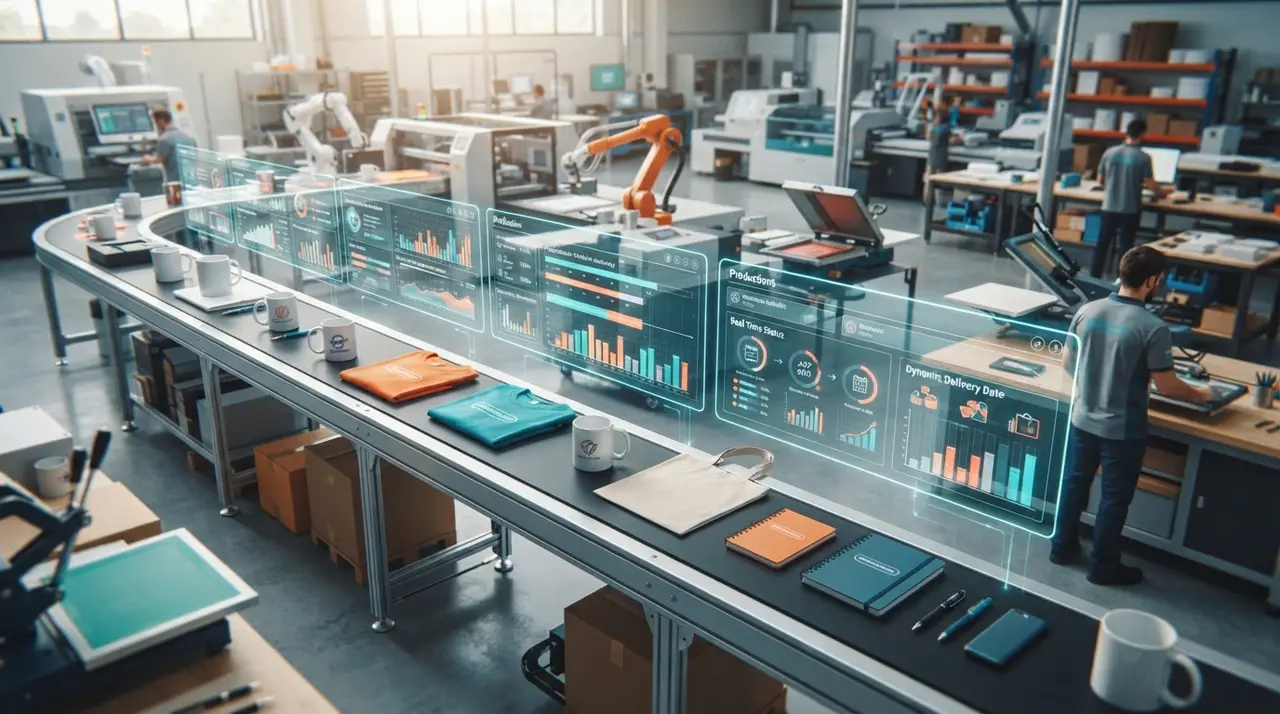
How AI Agents Calculate Production Capacity in Real Time
An AI agent for production deadlines calculates instant, accurate delivery dates by querying real-time factory queue capacity and ERP workflows during initial customer inquiries. By unifying live ERP data with conversational interfaces, custom product manufacturers eliminate unrealistic shipping promises and costly operational delays.
In custom promotional product manufacturing, quoting a turnaround time used to be an educated guess. Sales representatives often promise tight deadlines to secure a deal without knowing that the screen printing department is running three days behind or that engraving laser #2 requires emergency maintenance. When production inevitably stalls, the customer gets angry, customer support gets overwhelmed, and the factory bears the financial burden of rushed freight shipping.
By deploying specialized automation tools powered by artificial intelligence, manufacturers bridge the gap between initial sales conversations and actual shop floor reality. An intelligent agent connects directly via API to systems like Bling, Omie, ContaAzul, or custom ERPs. Rather than relying on static tables or manual check-ins with production managers, the system reads live load factors and calculates a dynamic delivery date in seconds.
Reading ERP Workflows, Product Complexity, and Machine Queues
Integrated AI agents evaluate complex manufacturing variables simultaneously before providing a buyer with a binding or estimated delivery date. The agent does not simply add a fixed offset like "5 business days" to every order; it evaluates multi-stage operations based on product attributes.
When a prospective client requests 1,000 customized stainless steel tumblers with laser engraving and custom box packaging, the AI agent instantly assesses several critical factors:
- Current queue load: The active work orders waiting at prepress, laser engraving, and final packaging.
- Product complexity rules: The setup time required for laser calibration versus simple UV digital printing.
- Material inventory: Stock availability in the ERP for raw blanks and packaging materials.
- Operational constraints: Factory shifts, weekend downtime, maintenance schedules, and current daily throughput capacity.
By processing these variables, the agent calculates a date grounded in actual shop floor metrics. If a buyer asks, "Can I get this by next Thursday?", the agent provides an honest, data-backed answer immediately—preventing sales representatives from making commitments the factory floor cannot fulfill.
Automated Delivery Estimates vs. Manual Guesswork
Replacing manual estimation with automated queue analysis converts guesswork into an algorithmic workflow. The table below compares how traditional sales quoting contrasts with an automated AI agent connected to your ERP stack.
| Evaluation Metric | Traditional Quoting (Manual) | AI Agent Quoting (Automated) |
|---|---|---|
| Quote Speed | 30 minutes to 24 hours (waiting on factory updates) | Instant (less than 5 seconds) |
| ERP Queue Awareness | Rarely checked during initial sales outreach | Direct API query on every incoming inquiry |
| Customization Complexity | Often generalized using flat lead-time estimates | Calculated dynamically per technique and SKU |
| Human Error Risk | High (miscommunication between sales and production) | Zero (driven strictly by live shop floor algorithms) |
| Customer Trust Impact | Low when deadlines are repeatedly missed | High due to transparent, realistic expectations |
To see how smart workflow architecture transforms sales and operations, explore our guide on AI strategies for custom product manufacturing.
Preventing Overpromising, Rush Orders, and Customer Frustration
Overpromising delivery dates is the leading cause of customer churn and margin erosion in promotional giveaways and custom gift manufacturing. Rushing an overdue job leads to overtime wages, expedited freight fees, high scrap rates, and compromised product quality.
When buyers receive realistic timelines from the outset, their satisfaction increases. If an order cannot be delivered within an aggressive timeframe, a humanized AI agent can politely explain the constraint, offer alternative high-speed production options (such as switching from silkscreen to direct-to-film printing), or propose an expedited production surcharge if machine buffer capacity exists.
This level of automated transparency preserves brand reputation and keeps factory lines running smoothly without constant emergency disruptions. Buyers appreciate knowing the exact status and delivery date upfront, which builds trust and encourages recurring corporate orders.

Real-World Case Study: How a Promotional Items Factory Transformed Deliveries
A mid-sized manufacturer of custom promotional merchandise faced recurring customer complaints regarding missed event deadlines. Their sales team frequently quoted standard 5-day delivery windows, unaware that the printing department was operating at 140% capacity during peak seasonal demand.
To fix this bottleneck, the company collaborated with an experienced AI agency, implementing IAChatbot to connect their WhatsApp business customer communication directly with their Omie ERP software. The results were immediate:
- Instant Quoting: Over 85% of incoming delivery timeline inquiries were answered automatically within 10 seconds.
- Accuracy Improvement: Delivery date accuracy increased from 68% to 98.5% over a six-month period.
- Reduced Sales Load: Sales managers saved over 15 hours per week previously spent calling production leads for status checks.
By leveraging real-world chatbot use cases tailored to manufacturing logic, the business scaled corporate sales without expanding support headcount or sacrificing delivery deadlines.
Implementing Humanized AI Agents in Your Production Stack
Deploying an AI agent for real-time schedule estimation does not require rebuilding your core ERP architecture. Modern integration frameworks connect your current management platforms with conversational interfaces via lightweight API webhooks.
- Define Capacity Rules: Map out standard setup times, machine hourly outputs, and buffer margins for each production technique.
- Connect ERP Endpoints: Enable webhooks or REST API queries between your inventory/production database and your conversational pipeline.
- Configure Conversational Logic: Utilize natural language processing so the AI understands user queries like "Can you deliver 500 embroidered caps by Friday?"
- Set Up Escalation Paths: Direct complex, high-value custom requests seamlessly to human account managers when custom engineering or art approval is needed.
Implementing tailored AI solutions allows custom factories to protect production schedules while offering modern, instant purchasing experiences for corporate clients.
Frequently asked questions
How does an AI agent know the exact shop floor capacity?
An AI agent connects directly to your ERP or production management software via API endpoints. It queries live job queues, machine availability, and current work orders in real time to calculate exact capacity.
What happens if a machine breaks down or production is delayed?
When factory managers update job statuses in the ERP, the AI agent immediately reflects these queue changes. It automatically adjusts future quoted dates and can send proactive updates to clients regarding affected orders.
Can the AI handle complex rules for custom products with multiple finishing steps?
Yes, custom workflow rules can be programmed into the system based on product attributes. The AI accounts for individual setup times, curing times, and sequential finishing steps before calculating the final shipping date.
Does replacing manual quoting with AI frustrate corporate buyers?
No, corporate buyers prefer fast, transparent, and realistic delivery estimates over delayed manual responses. A humanized AI provides natural, polite, and helpful responses while giving instant factual answers.