
AI Replenishment Agent: Critical Stock Alerts
An AI replenishment agent monitors critical stock like inks and fabrics, sending automated WhatsApp alerts to keep custom product factories running smoothly.
- AI Replenishment Agent
- Inventory Automation
- Custom Merchandise
- Commercial Automation
- ERP Integration

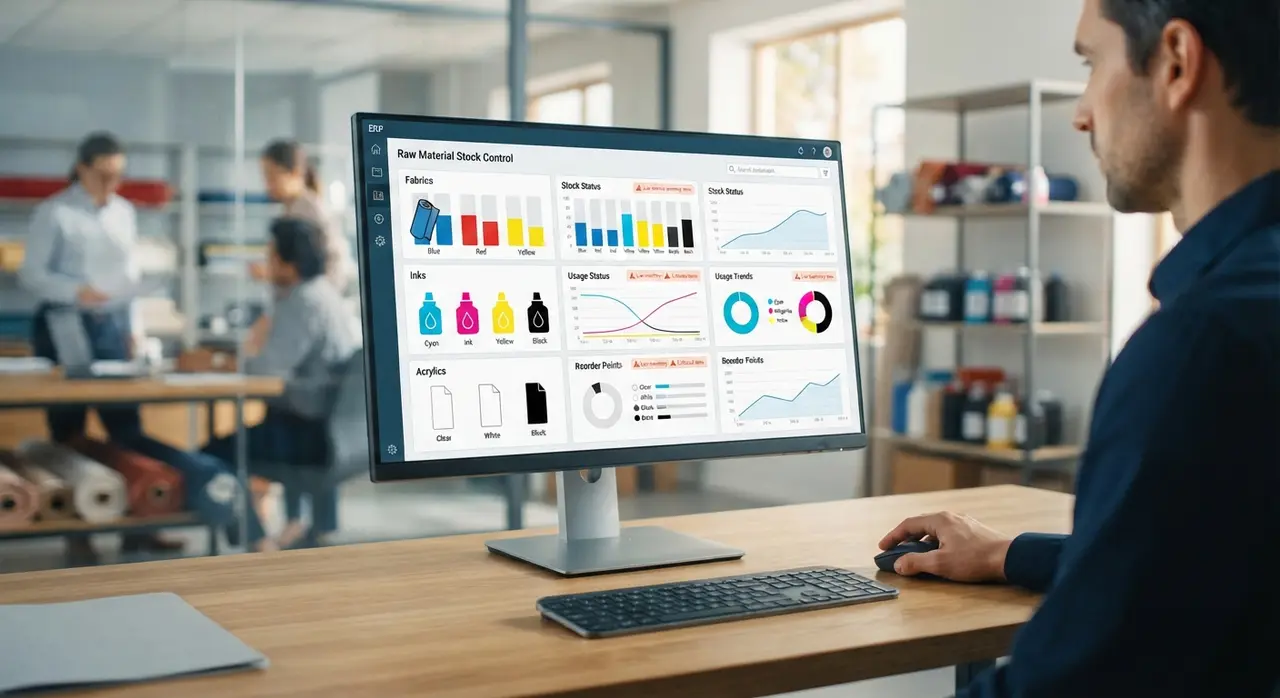
An AI replenishment agent is an automated software system that monitors raw material stock levels in real time through ERP integration and triggers immediate reorder alerts when critical inventory reaches minimum thresholds. Custom product manufacturers use these intelligent agents to eliminate expensive production line shutdowns, prevent material shortages, and organize supply purchasing well in advance.
Running out of essential materials like sublimation ink, acrylic blanks, specialized fabrics, or transfer paper destroys delivery schedules in the custom merchandise industry. When a factory halts production due to a missing batch of raw materials, operational costs skyrocket while customer trust plummets. Automated inventory monitoring ensures your workshop stays fully stocked without tying up unnecessary working capital in bloated inventory.
Real-time ERP integration transforms static stock data into proactive inventory control
Real-time integration between your enterprise resource planning (ERP) software and an AI agent converts static inventory records into dynamic, actionable purchase alerts. Most traditional ERP systems store current stock numbers, but they rely entirely on human managers to manually export spreadsheets and detect low balance levels before it is too late.
An AI agent connects to systems like Bling, ContaAzul, or Omie via continuous API calls, constantly monitoring physical inventory against active job orders. By analyzing historical consumption rates, lead times, and active sales pipelines, the agent calculates the exact reorder point for every raw material in your warehouse. To discover broader implementation strategies for production lines, explore ways AI boosts custom products output and cuts errors in modern factories.
This continuous monitoring removes human oversight errors from inventory management. Instead of discovering a lack of white ceramic mugs or polyester thread during order assembly, the factory receiving team knows weeks in advance when raw supplies need replenishment.
Setting dynamic reorder points for specialized custom product materials
Dynamic reorder points calculate precise lead times, historical usage velocity, and seasonal demand fluctuations to establish accurate safety stock thresholds. Standard static reorder numbers fail custom gift and merchandise manufacturers because material usage fluctuates dramatically based on seasonal promotional campaigns.
- High-velocity consumables: Sublimation inks, eco-solvent fluids, and transfer paper require high reorder thresholds due to constant daily usage.
- Custom substrates: Blank apparel, stainless steel tumblers, acrylic sheets, and wood plaques need lead-time buffers that account for supplier delivery schedules.
- Specialty finishing items: Custom ribbons, packaging boxes, and branded labels require lower volume thresholds but strict order tracking to prevent order dispatch delays.
By establishing item-specific rules inside the AI replenishment engine, factory directors eliminate guesswork. The AI continuously adjusts reorder limits based on active quote volume and confirmed purchase orders waiting in the production queue.
Connecting inventory health with commercial automation and customer acquisition
Commercial automation (automação comercial) links live inventory availability directly to your sales pipeline to stop reps from selling items with unavailable raw materials. When custom product manufacturers combine inventory intelligence with customer acquisition (captação de clientes) campaigns, sales teams only market promotional products that have guaranteed material stock.
When an essential raw material dips below its reorder point, the AI agent can temporarily flag corresponding finished product options in your quote generator or CRM. This prevents commercial teams from promising 48-hour turnarounds on items that require a two-week supplier lead time for raw inputs. Check out tailored AI solutions designed to align warehouse data with active customer support and sales channels.
Aligning commercial outreach with real-time material availability drastically reduces customer friction, quote revisions, and canceled orders. Your sales representatives gain total confidence that every order accepted by the system can be manufactured immediately without supply delays.
Leveraging WhatsApp message broadcasting for instant supplier and manager alerts
WhatsApp message broadcasting (disparo de mensagens whatsapp) delivers urgent inventory alerts directly to purchasing managers and pre-formatted purchase drafts to primary suppliers. Traditional email alerts often sit unread in busy inboxes for hours, whereas instant messaging notification channels achieve immediate visibility and faster decision-making.
When a critical item hits its minimum safety stock level, the AI replenishment agent generates a complete reorder summary. It includes current stock counts, recommended purchase quantities, historical unit prices, and preferred vendor contacts.
- Manager approval notifications: Sent instantly via WhatsApp with one-touch approval buttons to release the purchase order.
- Automated vendor outreach: Once approved, the agent formats and broadcasts the official requisition message directly to the vendor's commercial WhatsApp account.
- ERP status updating: Automatically logs the pending purchase order back into your ERP to reflect incoming stock expectations.
This automated loop reduces the purchasing cycle from days to minutes, ensuring vendors receive purchase requests long before raw material shortages threaten production schedules.
Comparing traditional inventory management with AI agent stock monitoring
Structured automation replaces reactive firefighting with predictable operational management. The table below illustrates the key operational differences between manual stock tracking, passive ERP reports, and an active AI replenishment agent.
| Operational Aspect | Manual Spreadsheet Tracking | Standard ERP Alerts | AI Replenishment Agent |
|---|---|---|---|
| Monitoring Frequency | Weekly or monthly manual audits | Daily static system batch updates | Real-time continuous API polling |
| Alert Mechanism | Manual email reports or verbal reminders | In-system dashboard notifications | Instant WhatsApp message broadcasting |
| Demand Forecasting | Historical estimates and gut feeling | Fixed minimum stock numbers | Dynamic calculation based on live pipeline |
| Supplier Order Drafting | Manual phone call or manual email creation | Manual draft creation inside ERP | Auto-generated draft sent with 1-click approval |
| Risk of Stockout | High (prone to human oversight) | Moderate (delayed response times) | Very Low (proactive automated warning) |
Mini-case study: How a custom promotional merchandise factory eliminated downtime
A mid-sized custom gift and apparel manufacturer producing over 15,000 custom items per month experienced frequent operational halts due to stockouts of white polyester apparel blanks and sublimation inks during peak corporate gifting seasons. These unexpected inventory lapses led to missed delivery deadlines, overtime labor costs, and dissatisfied commercial clients.
The company deployed a custom stock monitoring agent integrated with their ERP through IAChatbot. The AI agent tracked raw material depletion rates in real time, factoring in pending corporate orders, supplier lead times, and minimum safety margins. Whenever blank apparel or ink stocks reached critical thresholds, the agent instantly triggered a WhatsApp notification to the procurement leader with a pre-filled purchase order draft.
By implementing this automated monitoring loop with IAChatbot, the factory completely eliminated material-related production stops over a 12-month period, reduced raw material holding costs by 18% through optimized purchase timing, and improved on-time delivery rates to 99.4% across all promotional accounts.

Step-by-step implementation guide for custom merchandise workshops
Implementing an automated replenishment workflow requires clear steps to connect inventory databases with intelligent notification triggers. Review these actionable steps to launch an AI agent in your production facility:
- Audit your critical raw materials: Identify the top 20% of inputs (inks, specific fabric blends, substrates) that account for 80% of your production risk.
- Clean your ERP inventory data: Ensure stock unit measurements, vendor lead times, and current quantities are accurate inside your ERP system.
- Define buffer rules per SKU: Establish lead-time formulas and safety stock levels based on vendor fulfillment speeds and sales velocity.
- Integrate the AI agent via API: Connect the AI monitoring layer to your inventory database and WhatsApp Business API setup. Explore practical examples of AI implementation to see how API connections function across systems.
- Test automated alert triggers: Simulate low-stock scenarios to confirm that notifications reach procurement managers quickly with accurate order details.
Maximizing operational predictability and profitability with AI inventory agents
Proactive inventory control directly protects business profit margins by eliminating expensive emergency shipping fees, supplier rush charges, and unbilled overtime hours. When your factory operates with predictable material availability, production staff can focus on quality control and order turnaround rather than tracking down missing boxes of supplies.
Deploying an AI replenishment agent turns material tracking into an intelligent, hands-free competitive advantage. Custom products manufacturers that automate their supply chains retain better profit margins, keep commercial promises, and scale production capacity effortlessly without expanding administrative headcount.
Frequently asked questions
How does an AI replenishment agent connect to my current ERP software?
An AI replenishment agent connects to your ERP software via secure API integrations that pull live inventory, purchase order, and sales data automatically. It monitors stock movements across systems like Bling, ContaAzul, or Omie without requiring manual data exports or full system replacements.
Can the AI agent automatically send purchase orders directly to suppliers?
Yes, the AI agent can be configured to auto-generate purchase order drafts and send them directly to suppliers via pre-configured channels like WhatsApp or email. Purchasing managers can retain one-click approval authority or allow fully autonomous reordering for routine, high-velocity consumables.
What raw materials should custom merchandise factories monitor first?
Factories should prioritize high-turnover materials with long vendor lead times, such as specialized sublimation inks, polyester apparel blanks, acrylic sheets, and custom packaging boxes. Monitoring these critical items first delivers the fastest return on investment and prevents high-risk operational bottlenecks.
How does WhatsApp message broadcasting fit into inventory replenishment workflows?
WhatsApp message broadcasting instantly pushes urgent restock alerts to procurement managers and sends standardized order templates directly to verified suppliers. This rapid communication drastically shortens supplier response cycles and accelerates purchase order approvals compared to conventional email threads.