
Bling, Tiny or Omie: Best ERP to Scale Your AI Factory
Discover whether Bling, Tiny, or Omie is best to scale your custom product factory using AI, automated webhooks, and modern customer service bot workflows.
- ERP Integration
- Bling API
- Factory Automation
- Conversational AI
- Custom Products
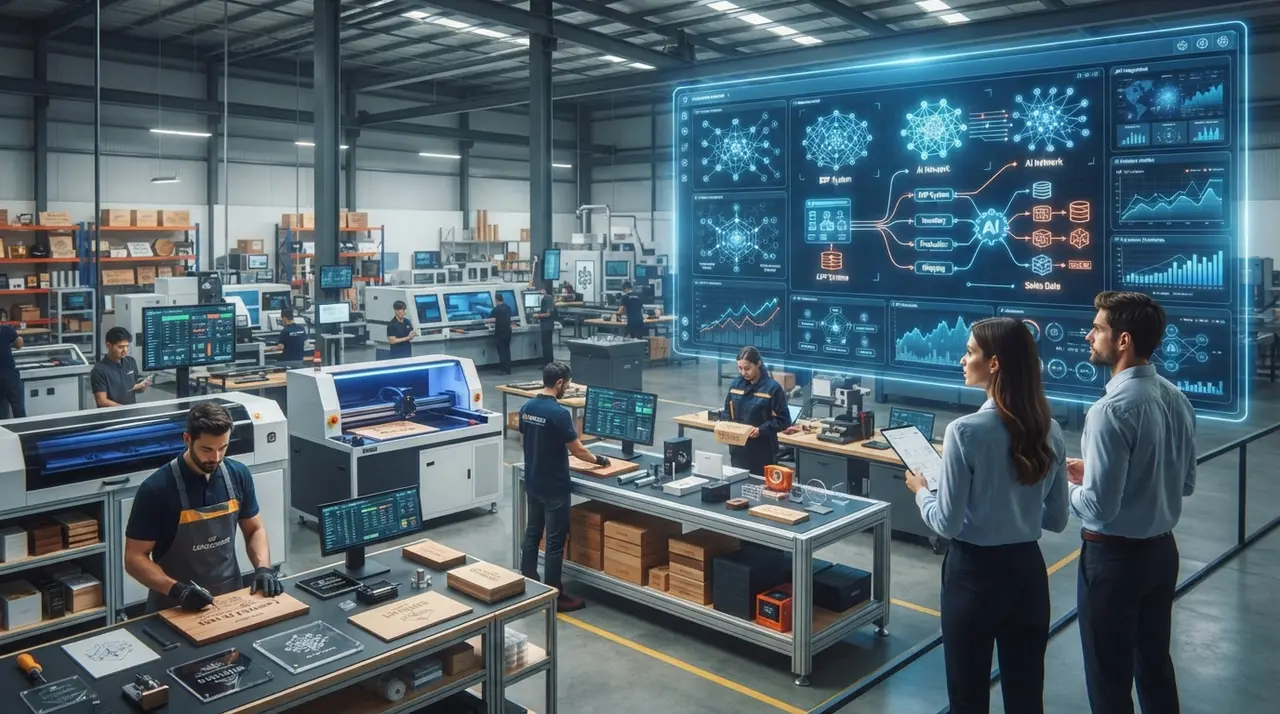
Choosing between Bling, Tiny, and Omie determines how easily a custom manufacturing plant can integrate a bot de atendimento and leverage the bling api for AI-driven automation. Selecting the right ERP architecture provides the foundation required to synchronize real-time inventory, quotation workflows, and production tracking across automated messaging channels.
For owners of custom merchandise, apparel, and promotional gift factories, scaling operations without adding overhead is the ultimate goal. When sales inquiries rush in through WhatsApp, your customer service representatives spend hours calculating custom quotes, checking stock of raw materials, and manually updating order statuses. Connecting your Enterprise Resource Planning (ERP) platform with conversational Artificial Intelligence transforms these manual choke points into instant, continuous automated workflows.
However, not all ERPs handle automated AI interactions equally well. The ideal software depends on your manufacturing complexity, daily transaction volume, and the open architecture of its application programming interface (API).
Evaluating Bling, Tiny, and Omie for AI-Driven Factory Automation
Selecting an ERP for an AI-automated factory requires examining system responsiveness, webhook availability, and data structure flexibility. A custom factory needs its ERP to instantly feed pricing matrixes, artwork approvals, and batch production statuses directly into external communication tools.
When an incoming lead asks for 500 personalized stainless steel tumblers with laser engraving, an AI system must query the ERP for base unit costs, recalculate custom tiered pricing, and report real-time production lead times. If your ERP limits daily API calls or lacks instant webhook triggers, your automated customer interaction stalls before a quote can be delivered.
Key Architectural Criteria for Custom Manufacturers
- API Rate Limits and Webhooks: How fast and frequently an external system can send and receive data without hitting technical throttling.
- BOM (Bill of Materials) Support: Ability to handle raw material deduction for customized products dynamically.
- Custom Fields Accessibility: Capacity to store artwork links, engraving text, print colors, and proofing approvals via API.
- Multi-Channel Order Sync: Direct synchronization between e-commerce storefronts, sales reps on WhatsApp, and shop-floor management.
Bling API and Capabilities for High-Volume Custom Manufacturing
Bling ERP is widely recognized for its accessibility, affordability, and extensive ecosystem of e-commerce integrations. For small to mid-sized custom product manufacturers starting their automation journey, Bling presents a very low barrier to entry.
The bling api (specifically its v3 REST interface) offers structured endpoints for products, contacts, orders, and financial entries. When combined with an intelligent virtual assistant, custom factories can query product variations, retrieve order progress, and issue quick quotes automatically. If your facility already relies on marketplaces or native web stores, Bling synchronizes multi-channel orders without complex custom code.
You can read more about leveraging these integrations in our detailed guide on custom products production automation using Bling API.
Where Bling Excels
Bling handles catalog management and standard billing efficiently. Its API lets external tools quickly create draft orders whenever a prospect approves a quote over WhatsApp. For personalized gift shops, corporate merchandise suppliers, and print-on-demand setups, Bling provides all essential sales and inventory hooks at a fractional cost.
Limitations to Keep in Mind
Bling’s native production module (PCP) is basic. If your custom manufacturing operation involves multi-stage assembly lines, machine scheduling, or complex bill-of-materials tracking, Bling may require external middleware or custom software layers. Furthermore, high-frequency API polling can occasionally hit rate restrictions during peak commercial hours, making real-time webhook design crucial.
Tiny ERP: Simplicity, E-commerce Native Sync, and Automation Bottlenecks
Tiny ERP (part of the Olist ecosystem) focuses on streamlined operations, fast order fulfillment, and seamless e-commerce platform connectivity. It offers a clean, user-friendly interface that reduces team onboarding time significantly.
From an automation perspective, Tiny provides structured REST APIs and native webhooks for key sales events. It allows external platforms to trigger order status updates, generate invoices, and manage inventory levels automatically when sales milestones are met.
Strengths for Growing Merchandisers
Tiny excels at simple custom products where manufacturing steps are straightforward—such as basic silk-screening, heat press transfers, or simple vinyl cutting. Its order separation and picking workflows are highly intuitive, allowing staff to move confirmed AI-generated quotes directly into shipping and invoicing pipelines with minimal friction.
Potential Bottlenecks for Scaling Factories
As manufacturing complexity increases, Tiny’s structural rigidity can become a limitation. Factories requiring deep custom manufacturing specifications (such as variable machine setup times, scrap percentage calculations, or multi-level assembly) will find Tiny’s standard product structure limiting. While its API is reliable, the data schema offers fewer flexible custom fields compared to higher-end enterprise systems.
Omie ERP: Advanced Financial Workflows, Production Modules, and Enterprise AI
Omie ERP targets mid-sized and expanding enterprise businesses requiring robust financial controls, advanced accounting automation, and dedicated manufacturing process management. Unlike lighter systems, Omie built its platform around comprehensive business management features and deep operational tracking.
For structured custom factories, Omie offers a dedicated manufacturing module capable of managing detailed operational routines, raw material requisitions, industrial cost accounting, and multi-step work orders. Its API infrastructure is built to support larger data payloads and higher request volumes, making it ideal for high-throughput automated factories.
To explore how Omie transforms industrial operations when paired with conversational platforms, check out our insights on Omie WhatsApp & AI factory integration.
Where Omie Outperforms
Omie handles complex operational realities effortlessly. If your custom factory prints high-volume corporate giveaways with detailed tax requirements, localized industrial compliance, and multi-stage production shifts, Omie provides the deep backend control needed. Its API allows conversational AI tools to create production orders, check precise manufacturing schedules, and query accurate credit terms for B2B buyers directly inside messaging channels.
Trade-offs and Investment Considerations
Omie carries a higher monthly investment and requires a more structured implementation process than Bling or Tiny. Small workshops with only two or three employees may find Omie’s operational setup overly complex for basic print runs.
Comparative Breakdown: Bling vs. Tiny vs. Omie for Factory Scaling
Comparing these platforms side-by-side helps clarify which ERP fits your current stage and long-term automation vision.
| Evaluation Feature | Bling ERP | Tiny ERP | Omie ERP |
|---|---|---|---|
| Ideal Factory Size | Micro to Small (1–15 employees) | Small to Mid (5–30 employees) | Mid to Enterprise (20–150+ employees) |
| API Robustness & Webhooks | Good (v3 REST, standard rate limits) | Solid (Reliable webhooks, structured data) | High (Enterprise-grade, high bandwidth) |
| Production Management (PCP) | Basic (Simple kit assembly) | Moderate (Standard order picking & manufacturing) | Advanced (Multi-stage work orders & BOM) |
| Implementation Speed | Fast (1 to 2 weeks) | Fast (1 to 3 weeks) | Moderate to Structured (3 to 8 weeks) |
| AI Chatbot Integration Ease | High (Widespread native ecosystem) | High (Clean order & inventory endpoints) | High (Deep financial & operational endpoints) |
| Cost Profile | Budget-friendly | Mid-tier accessible | Enterprise investment |

Integrating AI Chatbots, Webhooks, and Systems like API IXC for Custom Production
A high-converting factory automation strategy relies on connecting your customer-facing communication channels directly with your central database. Deploying a modern bot de atendimento on WhatsApp transforms customer service from a cost center into an automated revenue engine.
When a corporate buyer requests a quote for 2,000 custom branded backpacks, an AI assistant connected via API can instantly execute a multi-step sequence:
- Identify the Account: Check the buyer’s phone number against existing CRM and ERP contact records.
- Calculate Custom Pricing: Pull unit prices, apply tier discounts based on quantity, and calculate tax profiles using API calls.
- Verify Inventory: Query stock levels for raw fabric, zippers, and custom embroidery thread.
- Generate a Dynamic Quote: Send a formatted PDF or interactive message link containing price estimates, digital artwork previews, and delivery lead times.
- Create Draft Work Order: Automatically open an unconfirmed order in Bling, Tiny, or Omie once the client clicks approve.
In complex infrastructure environments—where factories operate across hybrid networks or manage specialized remote connectivity—tech architectures often integrate specialized interfaces alongside ERPs. For instance, teams utilizing broadband or telemetry infrastructure may connect software like api ixc to monitor factory IoT sensors, while keeping ERP APIs dedicated to financial and order processing tasks. Having open API standards across all systems ensures your automated AI agent can retrieve required operational data smoothly.
Real-World Case Study: How a Custom Print Factory Scaled with IAChatbot and ERP Automation
A mid-sized custom promotional merchandise manufacturer producing branded drinkware and acrylic awards faced major growth bottlenecks. The company received over 120 WhatsApp inquiries daily. However, three full-time sales assistants were drowning in manual quote calculations, artwork proof confirmations, and constant customer phone calls asking, "What is the status of my order?"
The management team integrated IAChatbot directly with their ERP system using automated API endpoints and webhook notifications. The outcome yielded immediate operational improvements across several key areas:
- Instant Automated Quotations: The AI agent handled initial inquiries, queried raw stock and tier pricing from the ERP, and returned detailed quotes within 30 seconds.
- Self-Service Order Tracking: Customers checked their production status on WhatsApp by entering their purchase order number, with the AI retrieving real-time manufacturing stage updates from the ERP.
- Reduced Sales Operations Overhead: Routine repetitive inquiry volume dropped by 68%, enabling the sales team to focus on high-value corporate accounts.
- Error-Free Order Entry: Approved customer specifications and artwork upload links were passed straight into the ERP via API, eliminating manual data entry mistakes.
By leveraging IAChatbot AI solutions, the factory scaled daily order throughput by over 40% without hiring additional customer service personnel.
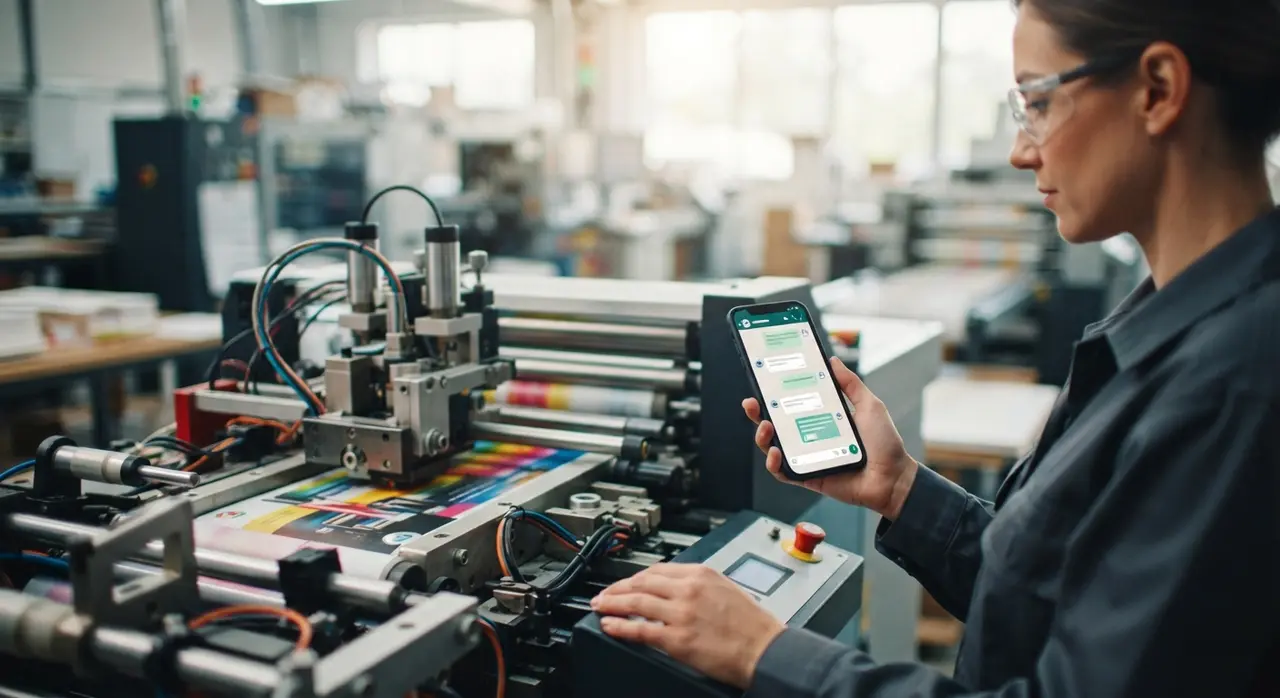
Actionable Step-by-Step Implementation Guide for Factory Owners
Transitioning your custom manufacturing plant to an AI-automated workflow requires an organized approach. Follow these step-by-step phases to ensure a smooth implementation:
Phase 1: Map Your Operational Workflow and Pricing Logic
Before connecting any API or AI tool, document how custom quotes are calculated. Define minimum order quantities (MOQs), setup fees, customization technique surcharges (e.g., UV printing vs. screen printing), and turnaround times.
Phase 2: Audit Your ERP Data Quality
Ensure your product SKUs, raw material components, price tables, and customer records in Bling, Tiny, or Omie are clean and up to date. AI agents rely entirely on clean database inputs to return accurate pricing and availability to customers.
Phase 3: Deploy AI Webhooks and Chatbot Triggers
Connect your chosen messaging channel (such as WhatsApp Business API) to an intelligent processing engine. Set up webhooks so that specific events—like a customer asking for stock, submitting artwork, or requesting an invoice copy—trigger instant ERP database lookup functions.
Phase 4: Train Your Team and Test Edge Cases
Run internal simulation tests before making the automated system live to customers. Test edge cases such as out-of-stock raw materials, special volume discounts, and complex multi-item quotes to verify that your ERP returns correct responses to the AI conversational interface.
Frequently asked questions
Which ERP is easiest to connect with an AI customer service bot?
Bling and Tiny offer the quickest setup for small factories due to their lightweight REST APIs and straightforward documentation. Omie is equally accessible for developers, offering robust endpoints tailored for mid-sized manufacturers requiring deeper production and financial automation.
Can I automate custom pricing calculations if my ERP only stores base unit costs?
Yes, your AI agent can receive base unit prices from the ERP via API and execute custom calculation scripts based on your specific customization parameters, quantity tiers, and artwork fees before delivering the final quote to the customer on WhatsApp.
Do I need to replace my current ERP to implement AI automation in my factory?
No, you do not need to switch software if your current ERP provides functional API access and webhook support. Platforms like Bling, Tiny, and Omie can all be retrofitted with AI chatbots and automated workflows without disrupting your existing database structure.
How does an AI chatbot verify inventory before taking a custom product order?
The AI system sends an automated API query to your ERP to verify real-time stock levels of base products and raw materials. If sufficient inventory is available, the bot proceeds with quote generation and order placement; if stock is low, it can suggest alternative products or alert sales staff.